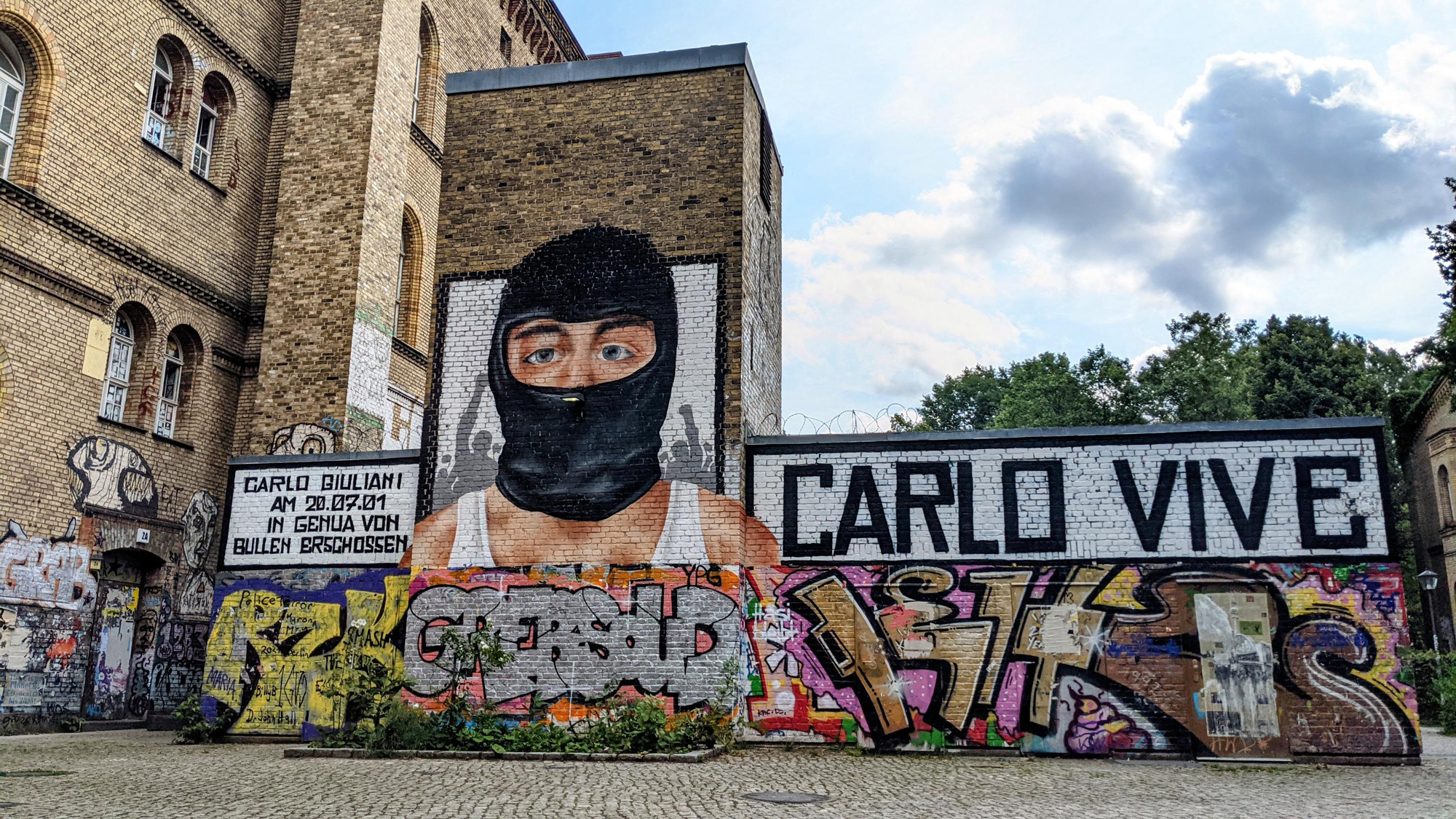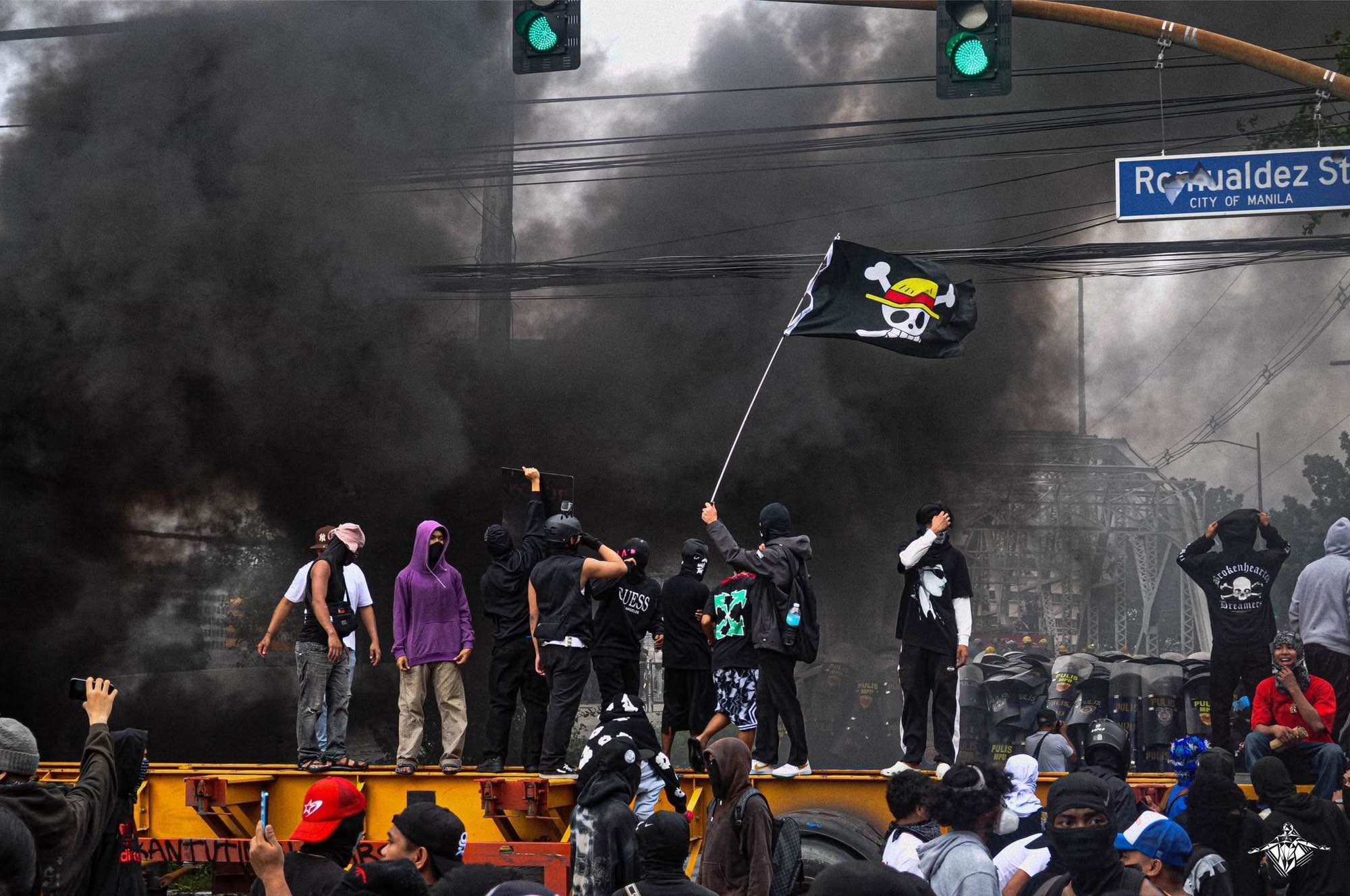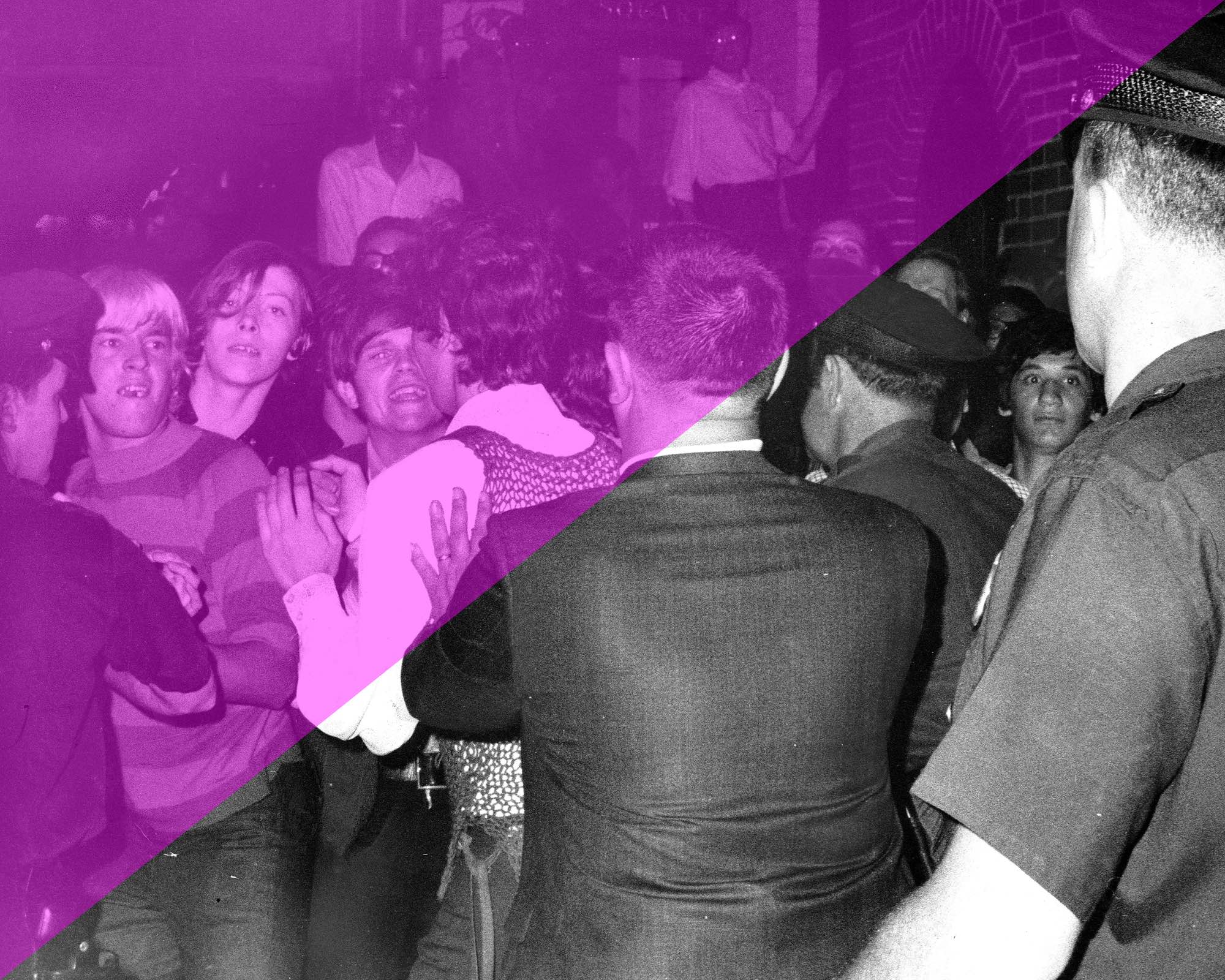

What can today’s rebels learn from the Stonewall riots? Why did the uprising have such an impact? To answer these questions, we explore the previously unacknowledged significance of anarchists in the rebellion and the movements that emerged from it. Along the way, we trace a queer genealogy of anarchist organizing methods in North America from the Stonewall Uprising through the WTO protests in Seattle in 1999 to today.
This is a massive, meticulously researched historical investigation. It’s a deep dive! For a shorter introduction to the subject, see our previous article, “Stonewall Means Riot Right Now.”
You can order a zine version of this article here in order to read it in print.
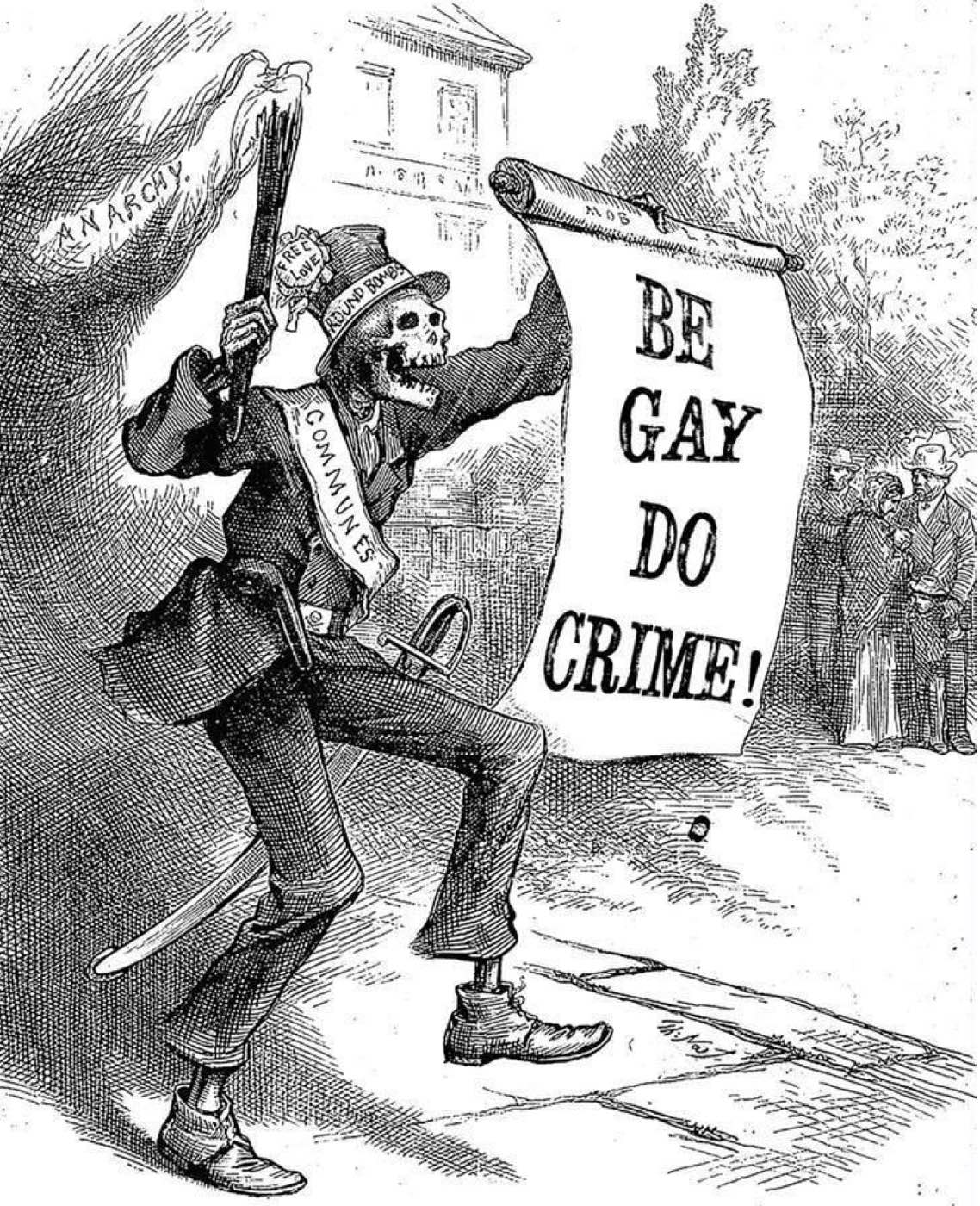
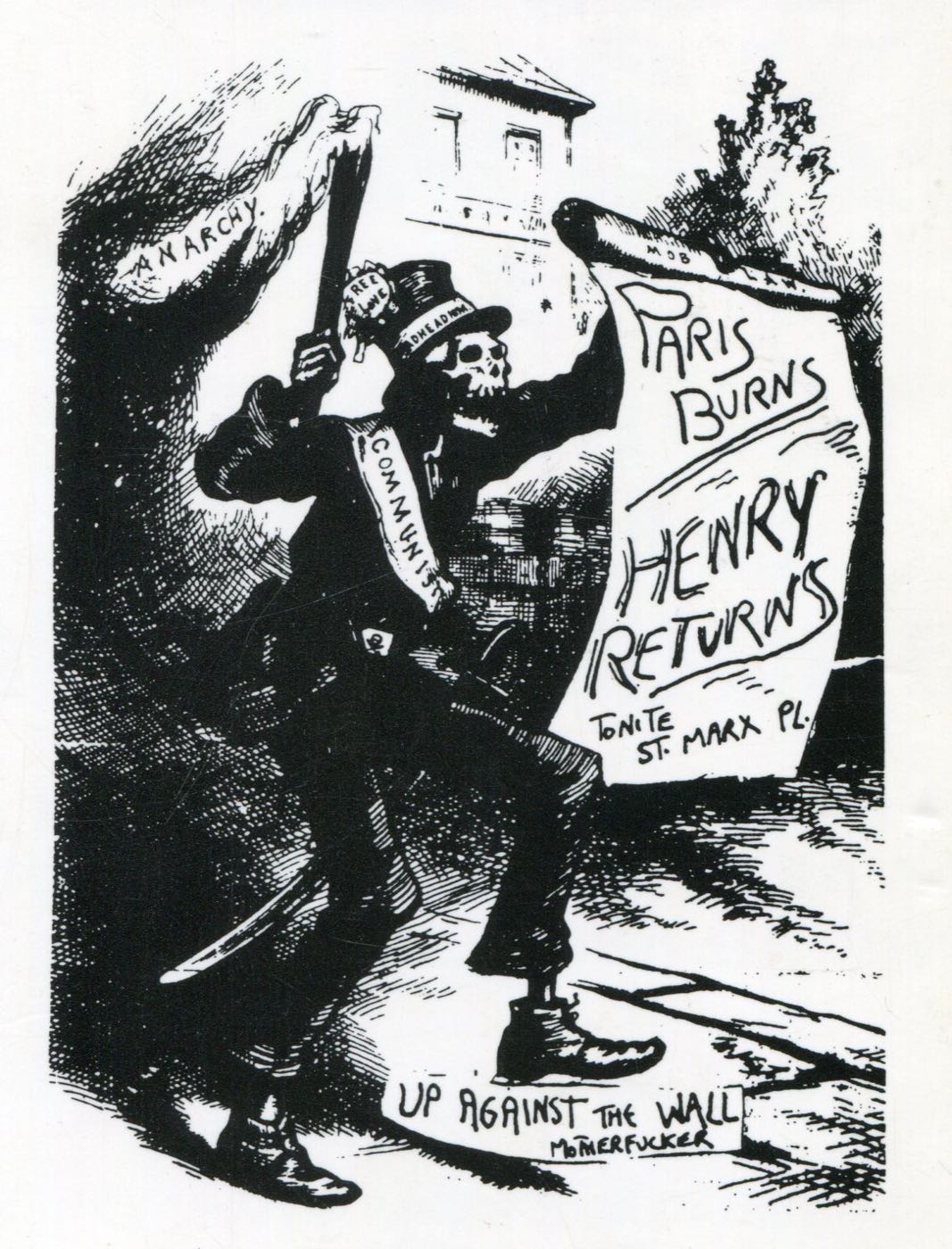
This image designed by the artist Bum Lung appeared in a book collecting the works of the Mary Nardini Gang in 2019. In fact, it repurposes the same Thomas Nast cartoon as a flyer that the anarchist group Up Against the Wall Motherfucker made in the 1960s. This connection gives us a glimpse of a subterranean relationship between queer subversion and criminal anarchism that spans decades.
“Be gay, do crime”? Let’s be more ambitious!
In 1969, gays and gender rebels were already criminals. At Stonewall, they became revolutionaries.
And if you’ve ever participated in an affinity group at a mass protest, you’ve got them partly to thank.
Here, we revisit the Stonewall Uprising and its aftermath to trace a queer anarchist history of riots and horizontal organizing. Despite Stonewall being the most famous moment in LGBTQ history in the United States, few have explored the anarchist dimensions of the uprising, nor its influence on subsequent radical organizing and tactics. Until now, queer anarchists who have invoked Stonewall have usually focused on it simply as an anti-police riot, an example of “queer ultraviolence” in which a wide range of sexual and gender rebels including trans people, people of color, and street youth fought back against their oppressors. This is accurate, of course, and were it only that, it would still be worth celebrating. But there is a specifically anarchist legacy at the heart of the rebellion, posing strategic and tactical lessons of interest to contemporary anarchists.
The history of queer anarchism has yet to be told. This is one of its riotous chapters.
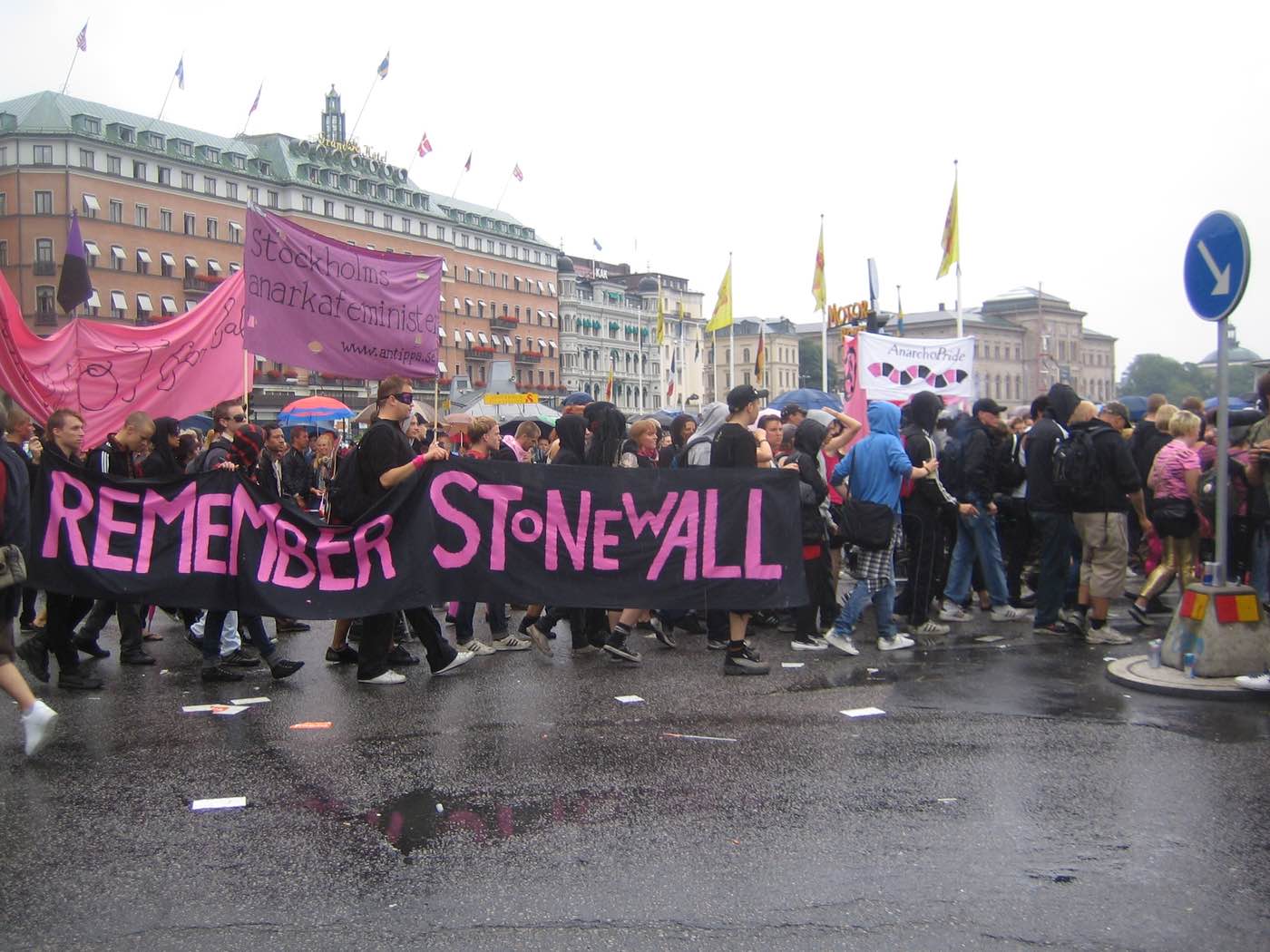
Queer anarchists around the world march to commemorate the Stonewall Uprising—let’s actually remember and learn from it.
If you, dear reader, are a queer and/or trans anarchist, we hope you’ll find particular pleasure in this account. But there are no identity-based limits on this legacy. All anarchists and rebels should find useful insights in the story that follows. Looking back through this history, it’s surprising how much of it—the discourse about outside agitators, identity, and local knowledge in riots, the debates about leadership and representation versus spontaneity and affinity, the counterinsurgency methods—resonates directly with our own experiences in more recent rebellions across a wide range of contexts.
Radical history should go beyond simply cheerleading our ancestors and trancestors; we owe it to them to learn concrete lessons from their successes and failures. The best way to honor the courage of the Stonewall rebels is not by putting their images on our walls or social media feeds, nor by squabbling over the proper version of identity politics to govern our thumbnail accounts of history.
It’s by drawing on their experiences to revolt more and better today.
—some queer anarchists
A Note on Sources and Historiography
We’ve researched this article using a range of primary materials (documents and accounts from 1969) as well as other historians’ writings about the events, plus interviews years later with folks who witnessed them. Where possible, we’ve included links to online sources that you can read yourself; otherwise, we have included footnotes to materials you can access in libraries. Many of the sources appear in the excellent anthology The Stonewall Riots: A Documentary Reader.
Some of the accounts directly contradict each other. We’ve done our best to sort through the various sources to pull together a well-supported overall narrative, acknowledging the limits of what we can know.
Objectivity is impossible. Yet our revolutionary aspirations will not be served by upholding mythologies that are emotionally satisfying but neglect the available evidence. A “usable past,” as we see it, isn’t an uncomplicated and inspiring fable full of hero/in/es to celebrate. It’s an analysis of history that offers lessons we can use to realize our own revolutionary dreams in the present.
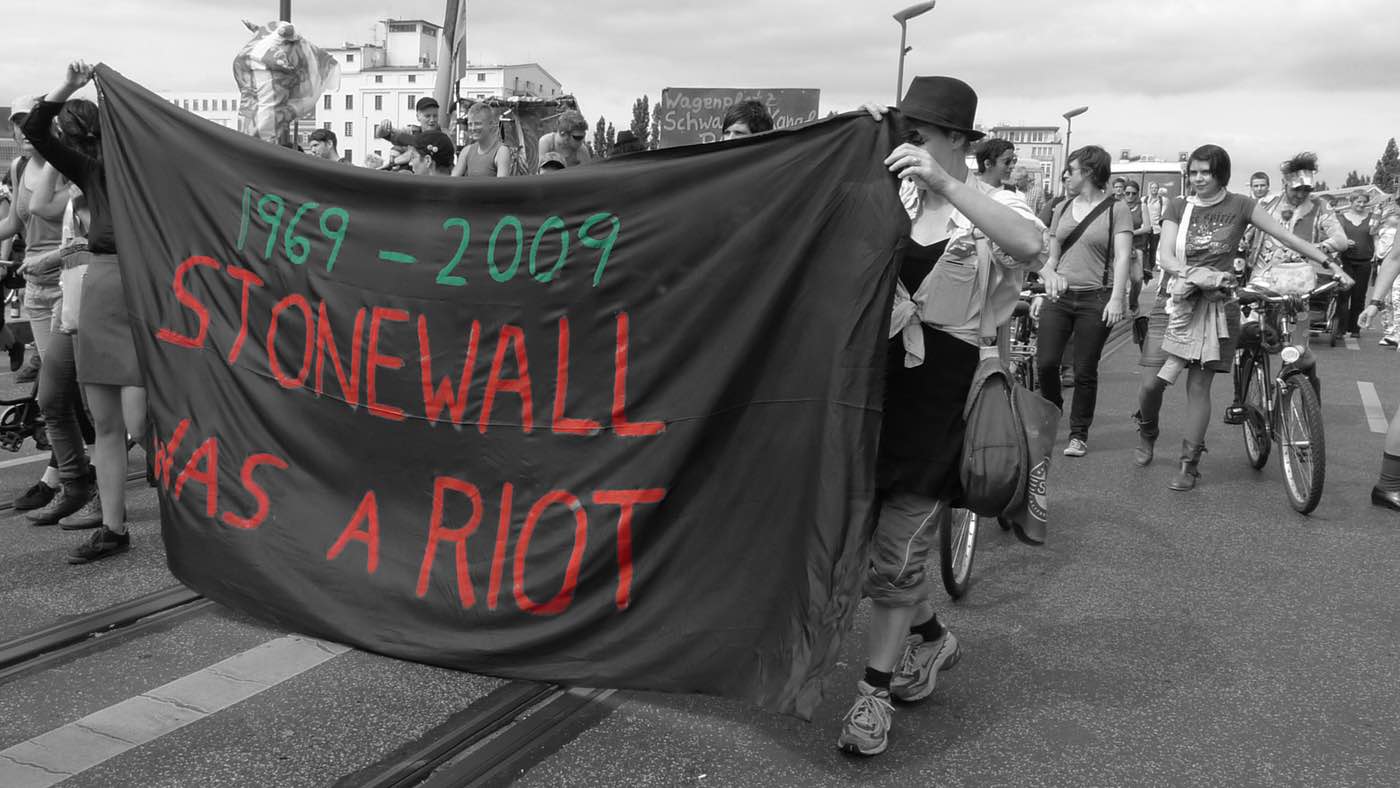
Yes honey, we know. But what can it teach us about revolt?
Why Stonewall Was Different
Stonewall wasn’t simply a night when the cops raided a bar and people fought back. The Stonewall Rebellion spanned three nights of intense rioting throughout Greenwich Village over the course of six days. This is critical to understanding why it made such a difference then and why we still remember it today.
It has become common to point out that Stonewall wasn’t the first queer riot. Commonly cited incidents include Cooper Do-nuts in Los Angeles (c. 1959) and Compton’s Cafeteria (1966). We can add to the list the Black Nite Brawl of 1961, also known as “Wisconsin’s Stonewall,” the gay community response to the Black Cat raid in 1967 Los Angeles, and various other pre-1969 rebellions.
Yet our hunger for a usable riotous queer past may exceed what we can actually document. The Cooper Do-nuts incident might have happened, but novelist John Rechy is the only person who claims to remember it (and wasn’t even sure what year it took place). More people claim to remember a tussle at Compton’s, but neither police files, organizational records, media coverage, nor gay nor trans periodicals from the time offer any mention of such an incident. It may have happened, but the details and even the date remain hazy—some time in August 1966 is the best guess. While inspiring to recount as an early example of collective trans and queer resistance, whatever impact such a disturbance may have had at the time was limited.
Other instances that are better documented, while locally significant, did not spread beyond their immediate geographic or tactical limits. The Black Nite Brawl, while fierce, was essentially a bar fight on a single night. When the Black Cat was raided in 1967, the gay community didn’t riot, though they did organize a nonviolent protest. None of these were widely discussed outside the communities where they took place.
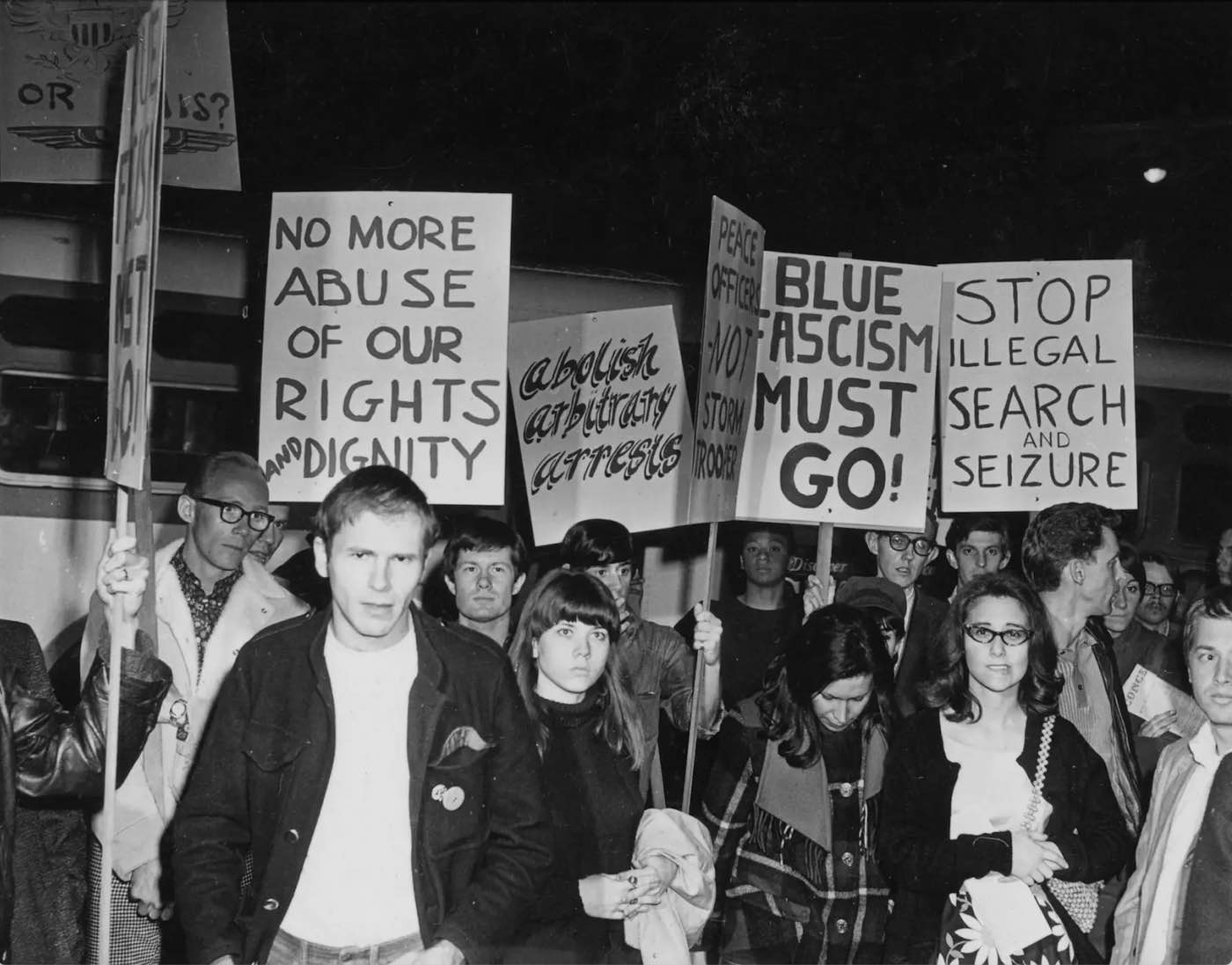
After the Los Angeles Police raided the Black Cat bar in Los Angeles in 1967, the gay community assembled to protest… but didn’t riot.
Surely there have been many times when queer and/or trans people fought back against oppression, regardless of whether they were documented in traditional archives or community memory. But before 1969, none of those directly catalyzed a deeper transformation in the queer/trans world beyond the immediate participants.
Stonewall was different. One of the reasons why is that it lasted so much longer. The entire neighborhood around the bar became ungovernable for nearly a week, with multiple escalating clashes that centered gay, trans, and/or gender non-conforming people but grew to include a range of neighbors, street kids, and political radicals. By sustaining the disorder for many days beyond the initial bar raid, the rioters shifted what it meant to be gay in the Village—and eventually, the world.
Had the 2014 riots in Ferguson died down after one night, they would not have catalyzed the international reckoning with police violence that became known as the Black Lives Matter movement. In the years before a police officer in Ferguson murdered Michael Brown, many one-night riots took place in response to police murders—but none lasted long enough to expand into a generalized rebellion. In Ferguson, locals kept coming back to the streets; this afforded supporters time to arrive, helping to sustain the intensity. The prolonged disorder caught the attention of the public, which eventually caused the protests to spread, making Michael Brown and Ferguson into household names. This is a useful analogy for what happened in the Stonewall riots.
Nowadays, people love to debate who “threw the first brick”1 at Stonewall. Actually, the question of how the rioting continued is at least as important as how it started. While the courage of those who resisted on the first night is admirable, it was the persistence of collective militant defiance in the streets over the following week that transformed it from a disturbance into a revolutionary upheaval.
One night, however fierce, could be a fluke. Stonewall was an uprising. Let’s see how it unfolded.
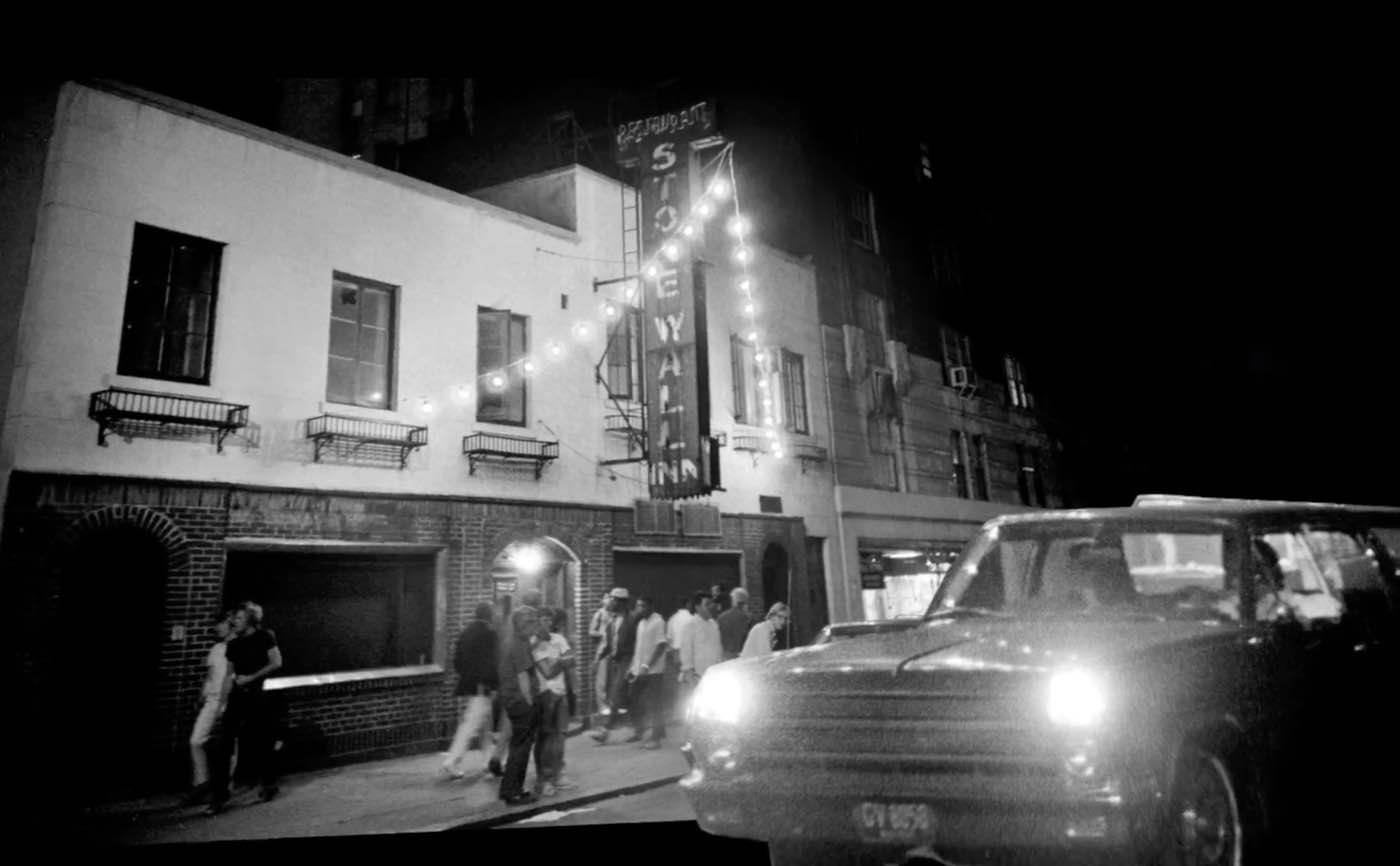
The Stonewall Inn before everything exploded.
The First Night: Fighting the Police Without Leaders
The basic story of the first night of rioting at Stonewall is widely known, though certain details about who did what remain contested.
Friday, June 27 was an ordinary night at the Stonewall, a trashy gay bar on Christopher Street in the West Village run by the Genovese organized crime family. The door was staffed by Ed Murphy, an infamous Mafia tough, pimp, blackmailer, and police snitch who later rebranded himself as a gay activist. A mixture of mostly young gay men and trans/gender-nonconforming folks sipped watered-down drinks from dirty glasses and danced, while outside the bar, more queers (including many too young to get in) congregated in the park and on the streets, laughing and camping and cruising.
Shortly after 1 am, police entered the bar and announced that they were raiding the premises. It was the second raid of the same bar that week, in addition to raids on other gay bars and the destruction of trees in a popular cruising area of a park in nearby Queens. As police sorted patrons for release or arrest, targeting trans people in particular, some begin to protest and physically resist. A crowd gathered outside, grumbling at the police and cheering and camping it up as people exited the bar.
Word spread through the neighborhood. As the police exited and began loading arrestees into a paddy wagon, tension built. A trans woman smacked an officer with her purse; a butch lesbian, struggling against her captors, yelled at the crowd to do something. From the swelling crowd, people shouted, threw pennies (a pun: “dirty copper!”), beat upon the police vehicles, pulled up cobblestones from the streets, and tussled with the officers. Losing control of the situation as the crowd grew larger and angrier, the officers retreated into the bar.
The crowd tossed bottles, stones, trash, garbage cans, and whatever they else they could find. They smashed windows, unarrested some prisoners, and pulled up a parking meter to use as a battering ram. Rioters attempted to set the bar on fire. Cops pulled their guns. More police arrived; as riot cops squared off, the crowd camped it up, chanting and dancing a kick line. For hours, the crowds clashed with police, dispersed and reassembled, set trash cans on fire, chanted, cruised, and milled around discussing their previous experiences with police.2
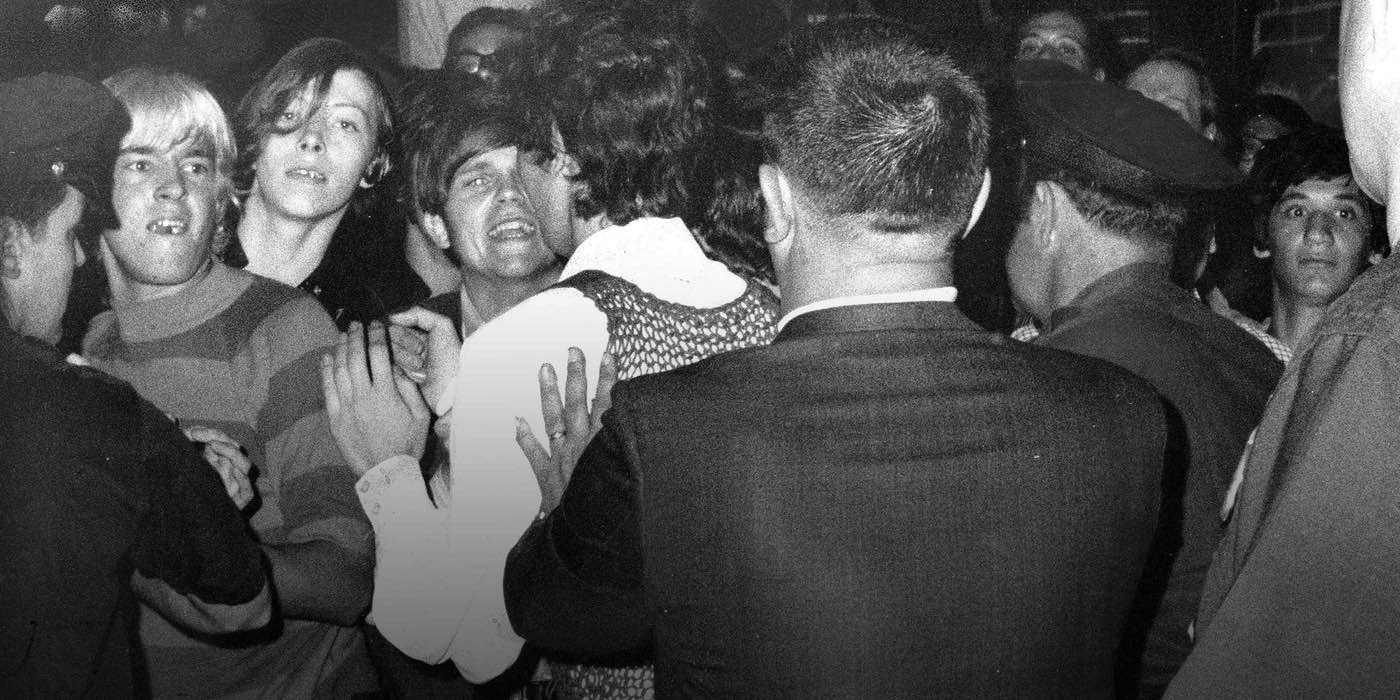
Friday night: the police raided and queers fought back.
As Martin Boyce recalled of the morning after:
Morning came on Christopher, and those broken windows and pieces of cloth inside and diamondlike glass all over. It was a riot, no doubt about it, and there were just exhausted survivors looking dazed. We knew what happened. We all did it… There was a certain beauty to the aftermath of the riot. It was a very extraordinary kind of beauty, something to make art out of later… The beauty of shattered glass and certain kind of fag decorations being blown in the wind, by the window. It was obvious, at least to me, that a lot of people really were gay and, you know, this was our street.3
For all of the ink spilled debating who played what role on the first night, all accounts agree that there were no leaders. No organizations, no formal structures, no representatives: the rebellion was a spontaneous collective outburst of rage and joy. Even attempts to chant slogans such as “gay power” or to sing civil rights anthems like “We Shall Overcome” didn’t take hold in an atmosphere of arch camp irony and fury. While efforts to take control of the riot’s legacy and bend its meaning to serve different political agendas began soon after, the first night expressed an organic, unmediated defiance. An observer writing in the countercultural newspaper Rat remarked on the absence of any effort to exert leadership as the uprising unfolded: “Strangely, no one spoke to the crowd or tried to direct the insurrection. Everyone’s heads were in the same place.”4
Many of the statements that established activists made early in the rebellion focused on the bars themselves, lamenting the system of mafia control and police payoffs. Craig Rodwell of the Oscar Wilde Bookshop circulated a flyer on behalf of his organization Homophile Youth Movement in Neighborhoods (HYMN) that declared, “The only way this monopoly can be broken is through the action of Homosexual men and women themselves. We obviously cannot rely on the various agencies of government.” Despite this anti-state sentiment, the demands asserted—for gay businessmen to run bars with “competitive pricing,” a boycott of Mafia-controlled establishments, and an investigation by the mayor’s office—suggested a limited imagination.5 While these conditions created frustration and vulnerability for many adult gay people, young queer people—ironically, precisely the constituency that HYMN claimed to speak for—were excluded regardless of who owned them, and trans/gender-nonconforming people of all ages faced additional legal and social harassment both inside and outside of them.6
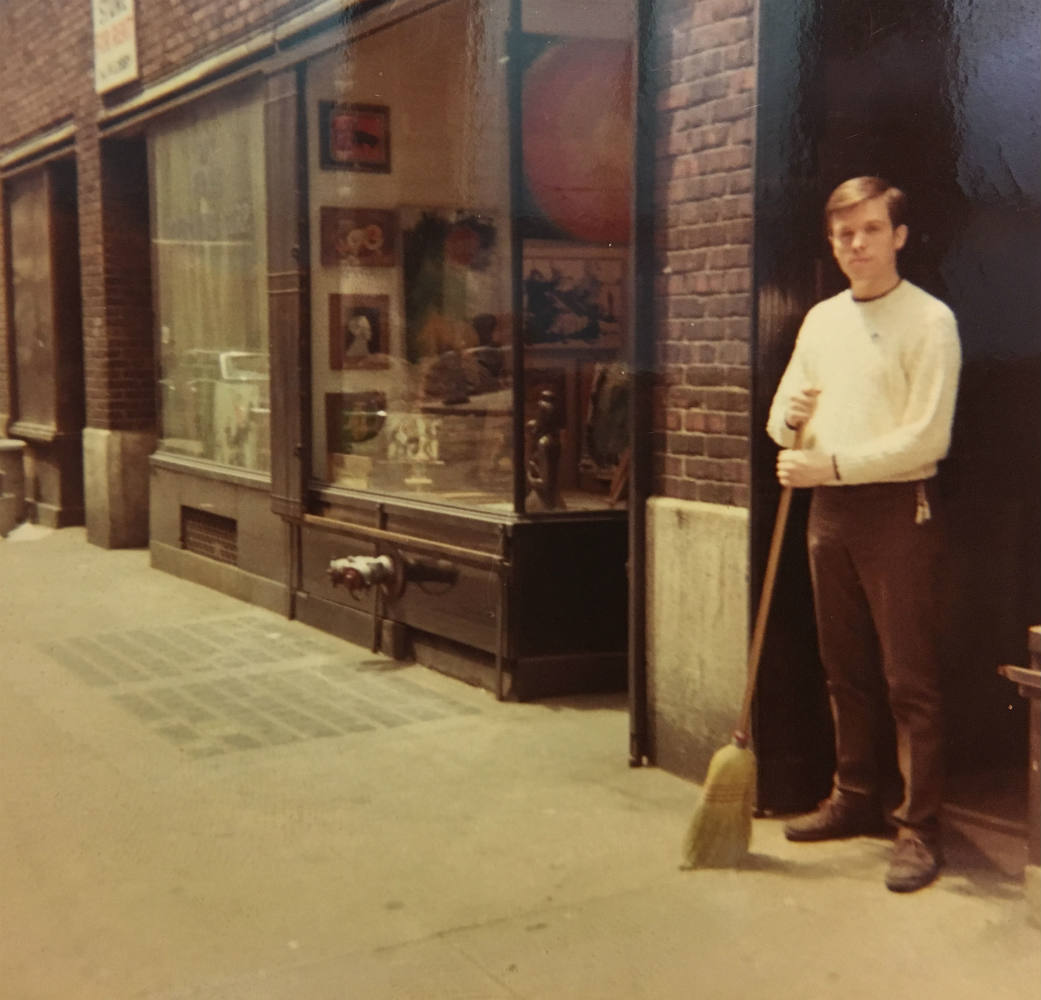
Craig Rodwell stands in front of the Oscar Wilde Book Shop in 1969.
Had the riots died down after one or two nights, such demands might have remained the thinkable horizon for many participants. However, the unrest persisted across many days despite the efforts of cops, politicians, and community representatives. The prolonged antagonism with police occupying the neighborhood and the ongoing congregation of angry, rebellious queers on the streets defying authority and sharing their experiences expanded the meaning of the uprising. Over the course of the week, what had begun as a grievance related to the bars became a window into a totally different world.
In addition to expressing being fed up and determined to resist, participants began to articulate sophisticated political analyses. One young gay rebel explained to a reporter the function of anti-gay oppression: “We strike at the family, and we undermine all the bullshit about virility that keeps most men in line.”7 These insights emerged collectively in real time as the rioters chatted and developed a shared political consciousness. An observer of the first night recalled:
People hung around till after 4 am talking in little groups. People were excited and angry. In talking to a number of kids who had been inside, it was evident most understood at least rudimentarily what was happening to them. What was and should have always been theirs, what should have been the free control of the people was dramatized, shown up for what it really was, an instrument of power and exploitation. It was theatre, totally spontaneous. There was no bullshit.8
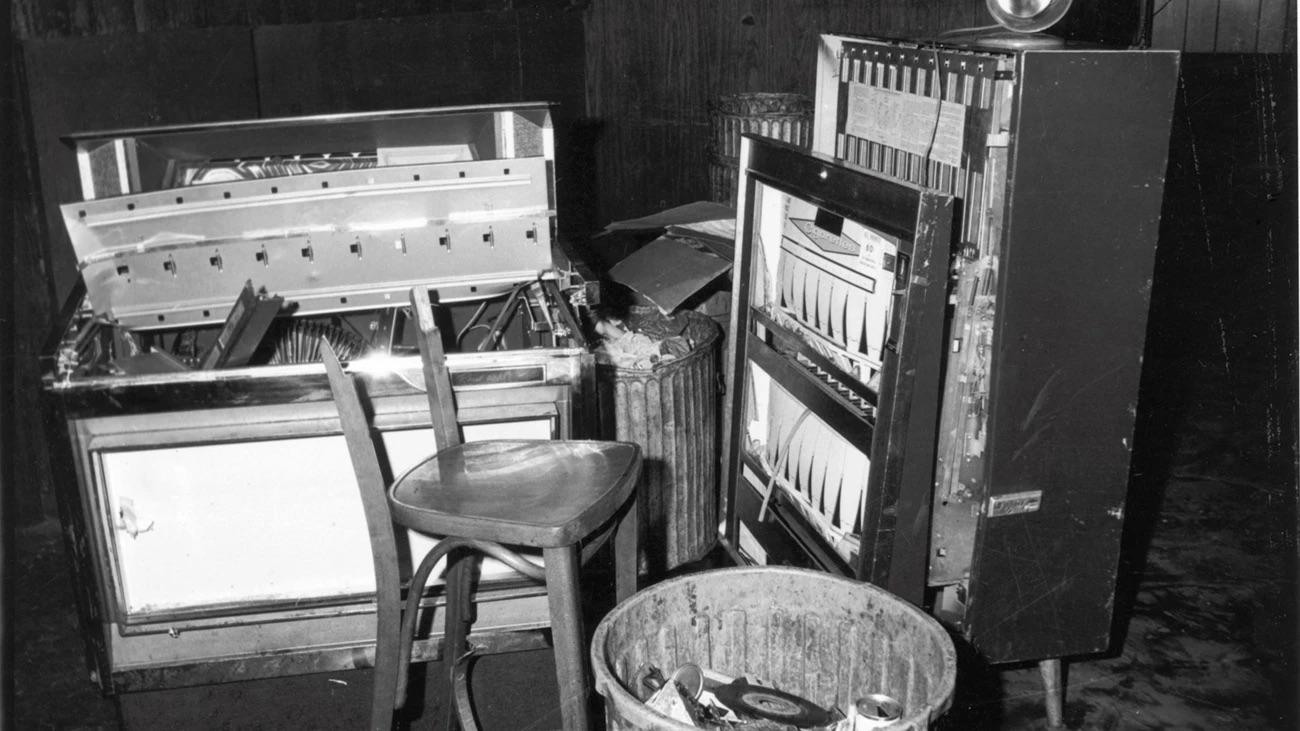
Day one: the raid and the riots left the bar wrecked.
The Second Night: The Gays, the Crazies, and the Motherfuckers
In a 2019 interview, Jim Fouratt, a longtime gay activist and former Yippie who was present for the entire Stonewall Uprising, recalled a detail that hasn’t made it into the published accounts of the riots. In his account, few radical groups participated on the second night of the uprising, but the Motherfuckers were there:
Do you know about the Motherfuckers? Straight anarchists, black flag kind of group… I did a lot of community organizing with the East Side Yippies and that kind of stuff. And my friend Ren de Antonio called me and she said, “I want you to know that the Motherfuckers are gonna come tonight and they’re gonna try to start a confrontation with the police.” And I said, “How do you know that?” She told me that there was a closeted gay man that she was good friends with in the Motherfuckers named Superdrill… she said Superdrill told me they’re gonna come.9
Did the Motherfuckers participate in the Stonewall Uprising? If so, what impact did they have?10 We may never be able to confirm with certainty what role the Motherfuckers played, but Fouratt’s recollection suggests a throughline connecting the forms of anarchist organizing on the streets of New York City in 1969 with the organizational forms that emerged out of the Stonewall Uprising. In any case, as we shall see below, multiple witnesses confirm that at least one other anarchist group was definitely involved in the riots.
Who were the Motherfuckers? Up Against the Wall Motherfucker (UAW/MF), also known as the Motherfuckers, emerged in the late 1960s out of organizing involving Dan Georgakas, Ben Morea, and several others. Inspired by Dadaism, Spanish Civil War veterans living in exile in New York City, and the Living Theater, Morea had launched a zine called Black Mask in 1966, turning the radical message of the avant garde against the corporate art world that had defanged it and reduced it to a spectacle. Over the months that followed, he and his companions carried out some of the boldest confrontational direct actions of the late 1960s while modeling a new form of horizontal organization.
Morea had attended meetings with Murray Bookchin at which they discussed how the Spanish anarchists of the FAI (Federación Anarquista Ibérica) had organized in grupos de afinidad during the revolution of 1936. Bookchin went on to circulate influential proposals about affinity group organizing through the writings and lectures of the Anarchos Group at spaces like Alternate U, a countercultural free school in Greenwich Village in New York City. At the same time, UAW/MF began to put a similar model into practice, organizing as a “street gang with an analysis,” forming cells that participated in confrontational actions against the art establishment, the police, and the military-industrial complex.
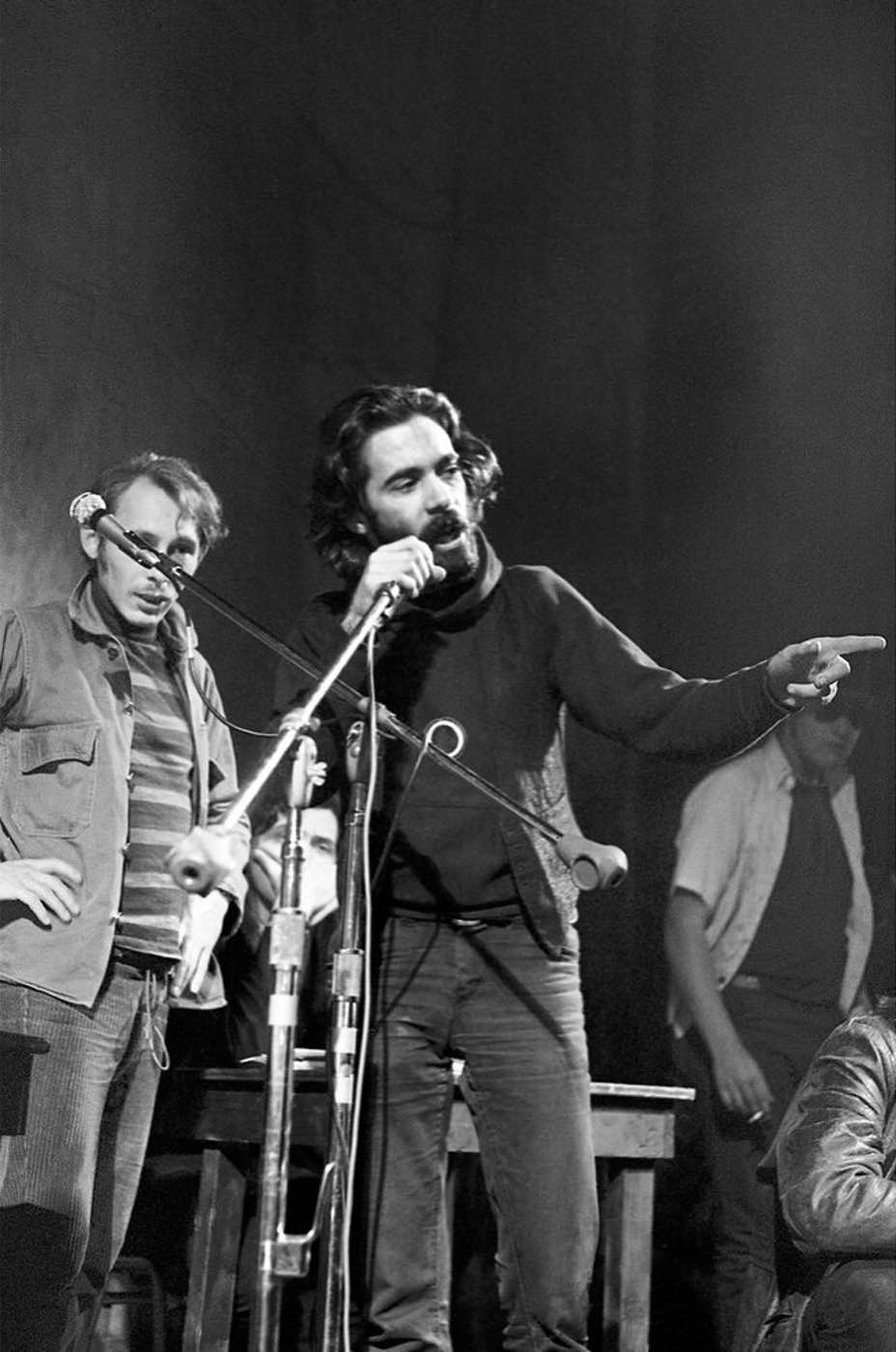
Ben Morea of the Motherfuckers, c. 1968.
In a leaflet titled “The Brown Bag Theory of Affinity Groups,” UAW/MF laid out their philosophy:
The affinity group is the seed/ germ/ essence of organization. It is coming together out of mutual Need or Desire. Cohesive historical groups united out of the shared necessities of the struggle for survival, while dreaming of the possibility of love. For man’s nature is not bounded by necessity alone — Desire appears in all its forms & man desires to desire — he seeks to fulfill himself on every level of his complex life. & it is in this psychological sense that the affinity group is a pre-organizational force, it represents the drive out of which organization is formed & in so far as it fulfills men’s desires it becomes the post-revolutionary form, the organization of satisfaction.
It is striking that the Motherfuckers articulated the logic of the affinity group not only as a response to political necessity or as a way to embody anti-authoritarian principles, but an expression of desire and the longing for love. Establishing collective living spaces, working together intensively, and sharing the risks and pleasures of life in revolt, UAW/MF formed a network they called “the family,” which, as Morea recounted, “shared a tribal outlook and lifestyle.” Deconstructing and replacing bourgeois structures of kinship was part of the group’s prefigurative vision. As the radical historian Caitlin Casey explains, “The Motherfuckers saw the nuclear family as a hopelessly outdated concept but their new family as presaging the postrevolutionary society.”
Morea later recalled, “The fact that we rejected the nuclear family model and lived collectively was never arrived at in a polemical fashion or laid out as a blueprint. We just had a sense that there were other roots to living other than what the West had to offer.” In this rejection of conventional family values in favor of new models driven by desire, love, and a vision of social transformation, the Motherfuckers—despite being a mostly heterosexual formation—promoted an anti-authoritarian vision that paralleled the queer practices that were emerging a few blocks west, where networks of street queens, queer teenagers, cruisers, and gay couples were building alternative worlds.
While these prefigurative models of alternative kinship overlapped with social realities in the Village, UAW/MF’s tactics were a far cry from any means of protest that organized gay groups had undertaken. Pre-Stonewall organizations such as the Mattachine Society of New York employed conventional hierarchical organizing models and limited their tactics to polite advocacy, which was undoubtedly bold for a time when same-sex sex was criminalized and police harassment bedeviled the community. The MSNY’s negotiations with Mayor Lindsay’s administration and the police department had managed to secure a reduction in anti-gay arrests in the years leading up to Stonewall. But while some individual gays and lesbians such as Jim Fouratt participated in more confrontational New Left or anarchist projects, the organized gay movement remained tactically conservative through 1969.
At a time when a broad social consensus, particularly among young people and marginalized communities, strongly opposed the Vietnam War and the US military machine, the first gay protest to take place in the city had been a 1964 picket outside the US Army Building advocating for the inclusion of gay men and lesbians in the military. The famous 1966 “sip-in” at Julius’s Bar in the Village involved men in conservative suits identifying themselves as homosexuals and then politely asking to be served in order to challenge State Liquor Authority policies that rendered gay bars vulnerable to closure. While courageous and in some cases effective, the homophile movement showed little tactical innovation. Younger activists’ efforts to propose even minor changes in the scope of actions—such as relaxing the conservative gender-conforming dress code imposed on participants in the “Annual Reminder” picket at the Liberty Bell in Philadelphia—provoked fierce backlash.
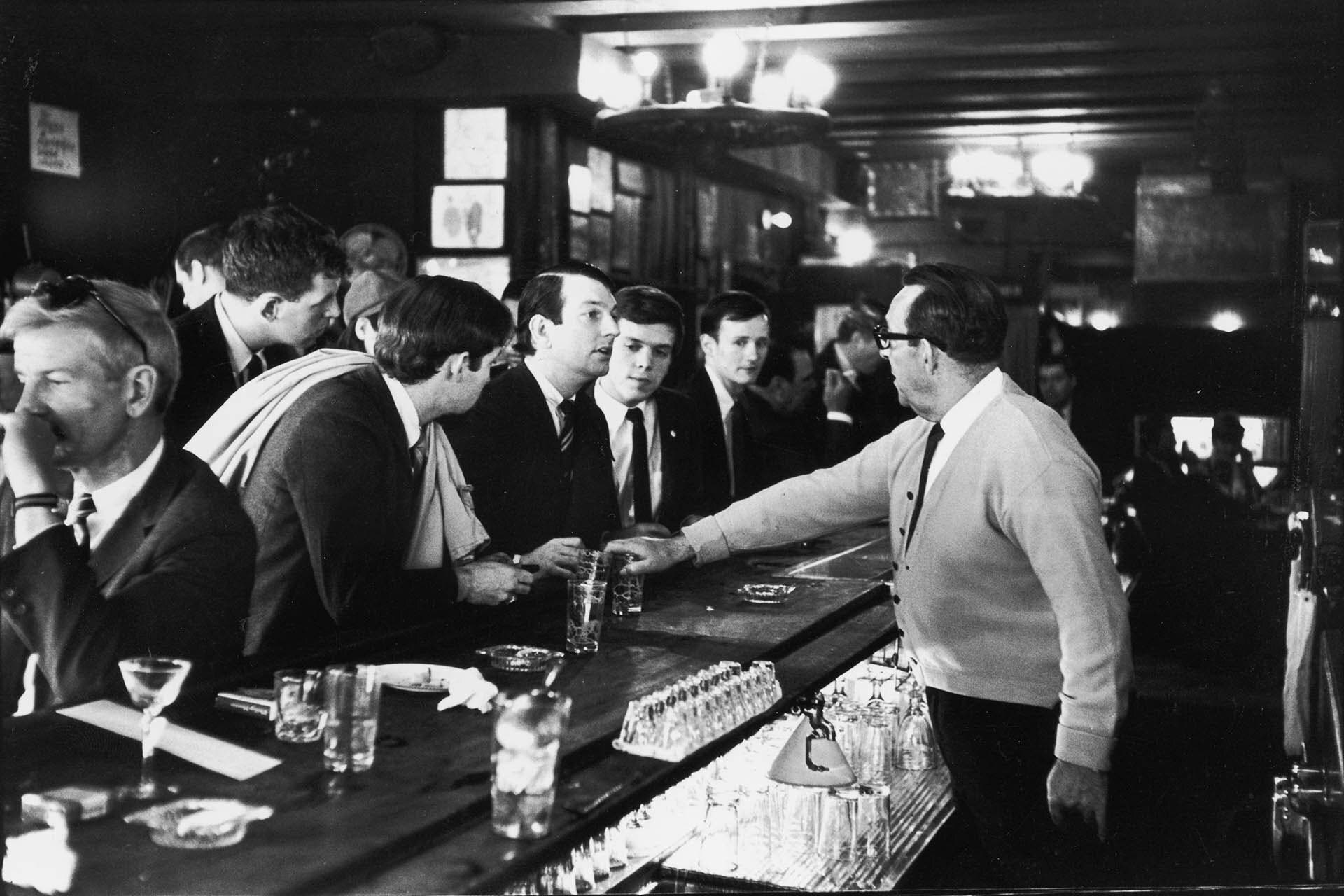
The famous “sip-in” at Julius’s Bar in the West Village, 1966. Dick Leitsch, president of the Mattachine Society of New York, is at center, addressing the bartender.
By contrast, on the Lower East Side, the Motherfuckers were pushing the boundaries of protest with near-constant confrontations, property destruction, and street marches. As former Motherfucker Osha Neumann recalled,
We would riot, throw rocks through the windows of the bank, and run through the streets chased by beat cops from the precinct reinforced by the Tactical Patrol Force. Those of us they caught got dragged to jail. Those of us who escaped rushed to our new storefront to churn out fliers calling for new demonstrations, which would invariably result in more riots and more arrests.
UAW/MF organized their own protests, but also appeared wherever social tensions presented opportunities for insurrectionary escalation. According to Morea, “We didn’t operate from any plan, we just saw situations and took our chances. We were edge dwellers.” When entering into a conflict, they did not confine themselves within tactical limits: “Our response would include everything from peaceful protests to not peaceful battling depending on the situation. We were extremely volatile and it often depended on how hard we were pushed.” The city presented ample opportunities for escalation, especially as the temperature rose; as a Motherfucker communiqué titled “Liberation in the Streets” declared, “While the rest tremble, we look forward to the heat of summer.”
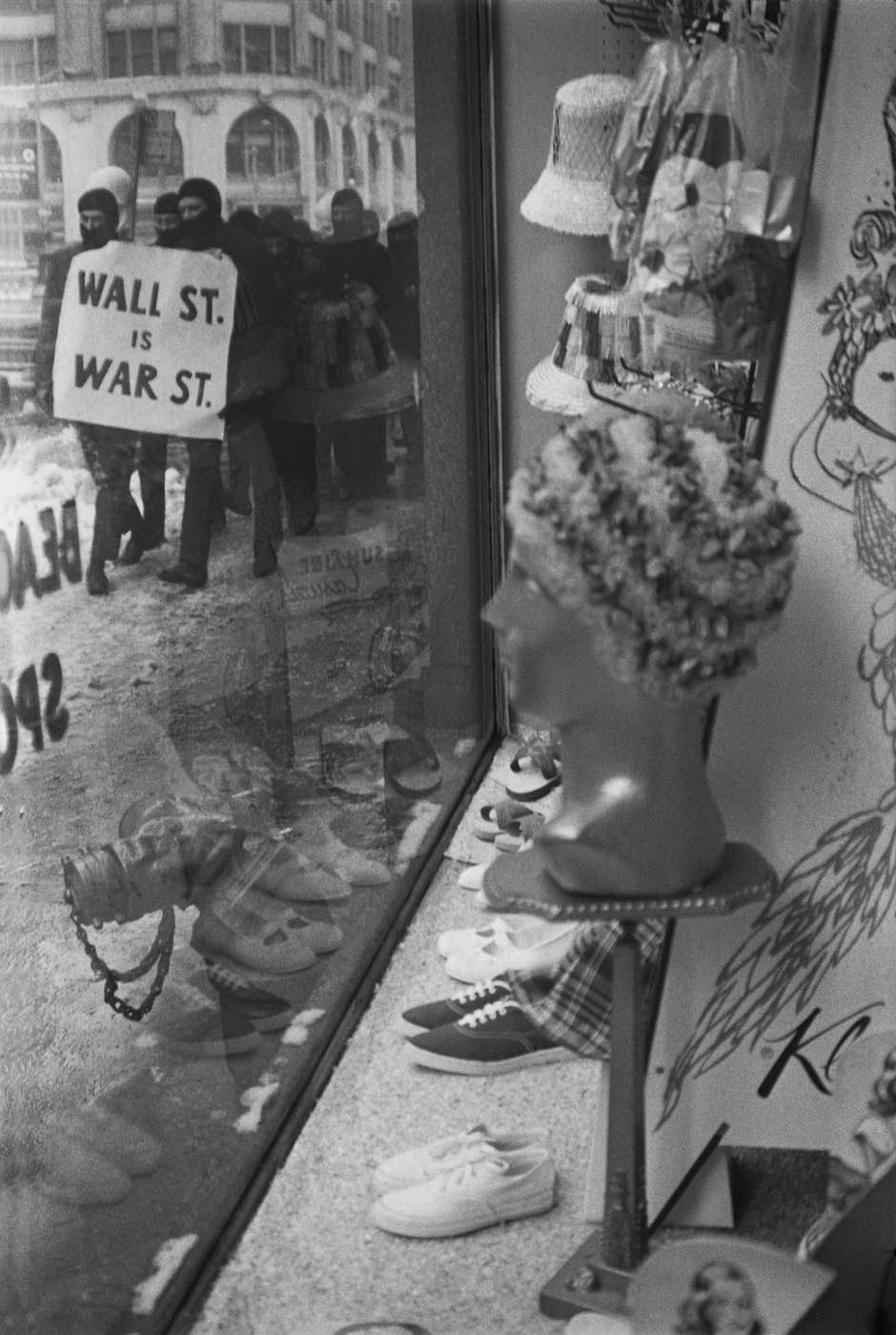
Black Mask, antecedents of Up Against the Wall Motherfucker, c. 1967.
Yet as summer of 1969 set in, few straight radicals anticipated that the most successful confrontation with the city’s notorious riot squad would come not from seasoned movement “heavies” such as Motherfuckers, Yippies, or SDS militants, but from young gay people in Greenwich Village. Many tough radicals from the New Left viewed the latter with contempt or amused indifference.
In fact, all accounts agree that in the Stonewall riots, it was specifically effeminate gays, street queens, and trans/gender-nonconforming people that took the most prominent militant roles. “People are beginning to realize,” one New York Post author quoted the doorman at the Stonewall Inn as saying, “that no matter how ‘Nelly’ or how ‘fem’ a homosexual is, you can only push them so far.” The author continued: “With a battle cry of ‘gay power,’ the Nellies, fems, gay boys, queens—all those who flaunt their homosexuality—have been demonstrating that they have indeed been pushed too far.”11
Dick Leitsch, president of the Mattachine Society of New York, noted, “The ‘butch’ numbers who were around the area and who participated peripherally in the action remained for the most part in the background. It was the ‘queens’ who scored the points and proved that they are not going to tolerate any more harassment or abuse.”12 A graffito on the sidewalk in front of the Stonewall: “BUTCHES, WHERE ARE YOU NOW THAT WE NEED YOU?”13
As word spread after the first night of rioting that a rowdy group of street queens and campy young gays with no formal protest experience had successfully squared off against the riot police, militants flocked to the Village to learn from their experience. As gay activist Bob Kohler recounted:
The big thing on everybody’s mind, especially the police and movement people, was that these were the only rioters that had gotten the best of the police. So that gave them a special strangeness. I mean, people just [wondered], How could that happen? Because there’d been riots with Yippies and there’d been riots with the SDS and Abbie Hoffman, but nobody had ever gotten the best of the police before. The police were never put on the run, and suddenly they were put on the run by the fairies, so those people were very curious: did this really happen?14
As the day unfolded, radicals and countercultural people of various sexualities and genders converged on the Village, mingling and discussing the events. One lesbian recalled, “Hippies joined the queers & straight places turned gay for the week-end—it was complete madness in NYC.”15
In addition to the likely presence of the Motherfuckers, multiple participants confirm the presence of the Crazies, an anarchist cell based in Lower Manhattan that participated in street theater, confrontational protests, and—as came out a few months later—bombings of targets connected to United States militarism.
Author Edmund White reported, “A mad left-wing group of straight kids called the Crazies is trying to organize the kids, pointing out that [Mayor] Lindsay is to blame.” John O’Brien, a Marxist activist with links to various radical groups experienced in street confrontations with police, reached out to the group to ask them to come on Saturday.16 While it is not known which individual Crazies were at Stonewall that night, participants in the group included Robin Palmer and Sharon Krebs, who went on to join the Weather Underground, and Sam “Mad Bomber” Melville. Five months after Stonewall, Melville was arrested en route to a planned bombing due to information passed by George Demmerle, an FBI snitch involved with the Crazies. Melville became a leader in prison organizing at Attica; he died at the hands of police and National Guard troops in the massacre that concluded the Attica Rebellion.
As night fell on June 28, the second night of the Stonewall riots, the crowd swelled to include thousands of people. The vibe was at once angry and festively campy. Participants surged into the streets and blocked traffic, chanted, confronted vehicles, and began to throw things. At the nearby Women’s House of Detention, which confined many Black and Latina lesbians and transmasculine folks, detainees cheered and dropped burning pieces of toilet paper out of the windows of the jail to show their support.17 Angry gay and trans people began attacking police cars. Marsha P. Johnson reportedly climbed a streetlamp and dropped something heavy on a squad car, smashing its windshield, while someone else tossed a bag of wet garbage into the face of an officer in another vehicle.
After 2 am, the TPF riot police arrived to reinforce the badly outnumbered officers, advancing in wedge formations in an attempt to clear the streets. Queer demonstrators confronted them with taunts and kick-lines and, when forced out, escaped along side streets to disperse and then reassemble elsewhere. Setting fires in trash cans, attacking police outnumbered by the crowds, and successfully unarresting and freeing some of those snatched by the riot squad, queers continued to flood the streets until after 3:30 am.
The success of the crowd in evading police, holding the streets, and sustaining the confrontation for hours likely stemmed from the combination of different demographics that converged on the second night. Gay residents and street queens drew on their intimate knowledge of the local terrain to find escape routes around police blockades, enabling rioters to disperse and reconverge, outflanking police efforts to re-establish control. Anarchists and other militants drew on their experience in street protest to escalate confrontations and defend against police violence and arrests. The gays, Motherfuckers, and Crazies proved a formidable coalition.
Fouratt was thrilled about how the second night went:
We learned through the end of it when I, when our little group met again, full of ourselves because it had been more successful than we had expected, many more people came out, it was just wonderful. I remember marching across Waverly Place in the wrong direction, going by Julius’s and shouting, “Come out! Come Out! Come out!” And they’re all raising their drinks, but not coming out! … I don’t claim to be the first person to say, “Come out! Come out!” But on the second night, that was the mantra, the cheer that you heard.
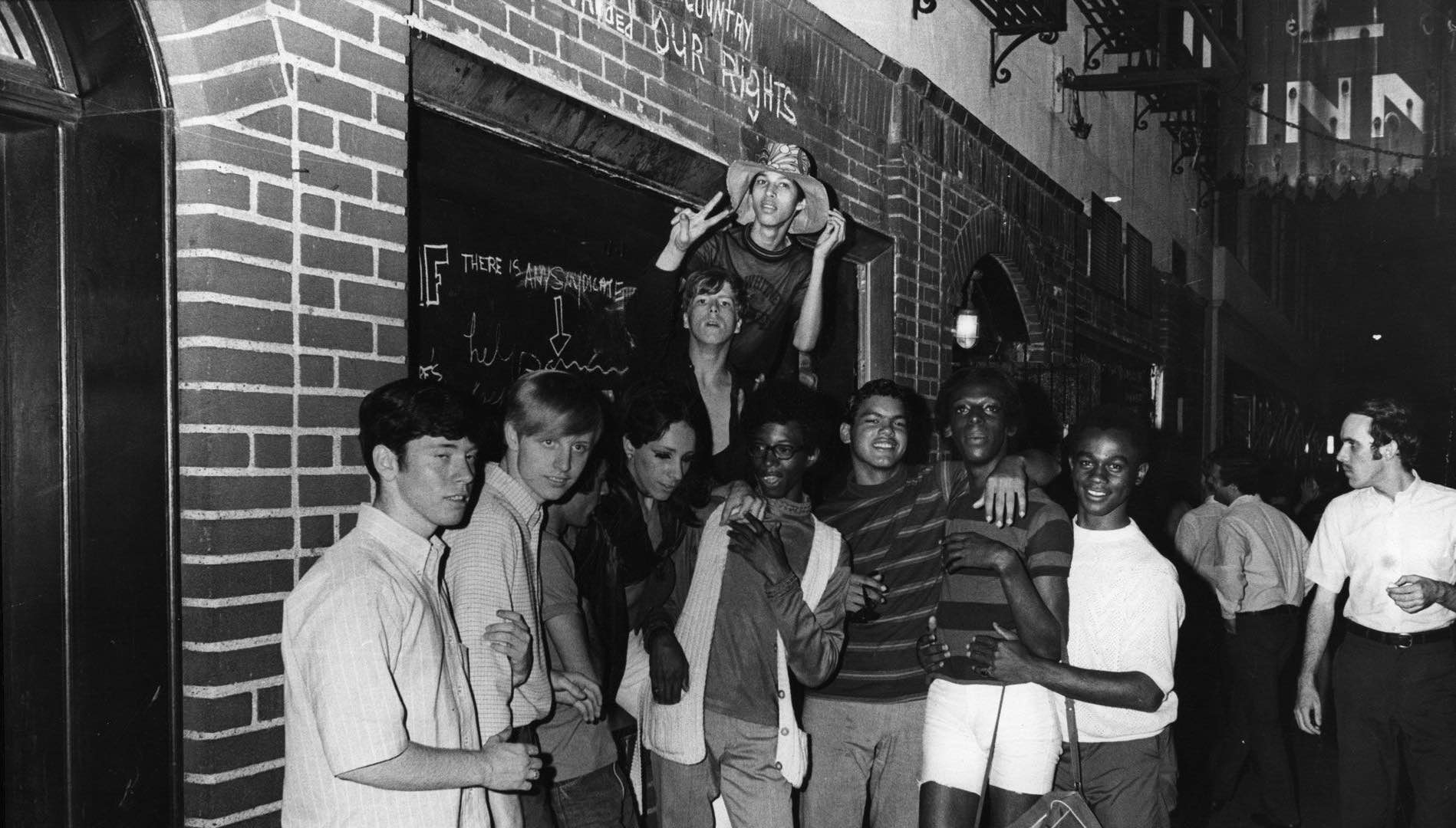
Saturday night: Stonewall belongs to the kids on the streets.
June 29 - July 1: A Lull, and the Failure of Counterinsurgency
On the third night, Sunday, June 29, large crowds once again turned out, but the fierce confrontations that marked the first two nights did not take place. As David Carter explains, the police had learned
that in the aftermath of Friday night’s raid it would take many more police officers than were initially deployed on Saturday to discourage gay men and women and their allies from attempting to seize the area around the Stonewall, which the homosexual citizens saw as their turf; that the police needed to arrive early in large numbers to preempt the gay citizenry from seizing the initiative; and that such a maneuver must be executed in a low-key manner or their mere presence might precipitate the outbreaks they were hoping to end. (At least the police used this approach on Sunday night and it worked.)18
A gay activist writing in the Berkeley Barb also claimed that activists from SDS had promised to lend their support, but failed to show up on Sunday night.19 If the Motherfuckers returned, their presence was not felt. Other factors contributed to muting the rebellion:
The second factor working in the police’s favor was that the weekend had passed. Friday and Saturday nights’ events had begun late and lasted until the early morning, something most people could not do on an evening before a workday, especially if they had already done so on the previous night or two. Thirdly, some of the demonstrators felt that they had already made their point and nothing more was to be gained by again repeating what was becoming a predictable scenario. Was it worth risking more injuries and arrests, as well as damage to the neighborhood that gay people were fighting to claim as their own?20
Furthermore, earlier in the day, Mattachine activists had met with representatives of the mayor and police department and attempted to dissuade the gay community from continuing the rebellion. At the Stonewall, MSNY members encouraged people who turned up to go home, posting a sign reading: “WE HOMOSEXUALS PLEAD WITH OUR PEOPLE TO PLEASE HELP MAINTAIN PEACEFUL AND QUIET CONDUCT ON THE STREETS OF THE VILLAGE—MATTACHINE.”
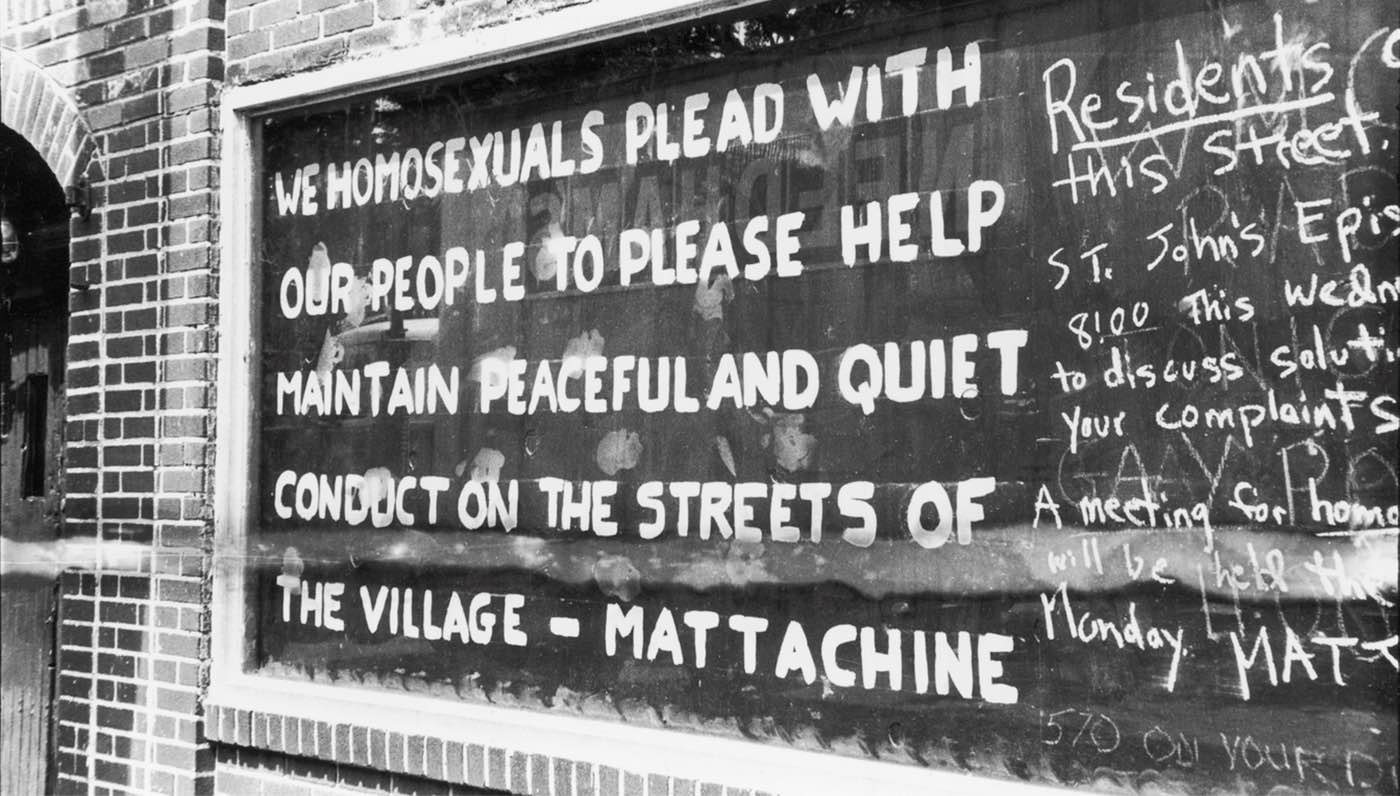
An attempt at counterinsurgency. It didn’t work.
MSNY’s actions reflect a familiar pattern of co-optation and counterinsurgency, in which the self-appointed representatives of an oppressed group attempt to pacify their constituency in order to maintain their status as intermediaries with the dominant power structure. This model is familiar from Ferguson to Standing Rock to Minneapolis; it represents one of the most serious threats to the revolutionary potential of social movements.
However, at Stonewall in 1969, the elation at the possibilities opened up by the riots, the limited influence that the Mattachine Society had upon the street youth who comprised the front line of the rebellion, and the hatred that the vast majority of the community felt towards the police combined to limit the effectiveness of this strategy. The crowds remained large, if less rebellious than the night before, and an array of defiant actions took place. As Carter recounts,
Several gay youths took daring advantage of the heavy police presence in the Christopher Street area to make a guerrilla raid on the Sixth Precinct’s headquarters. They went to the police station and slapped Day-Glo blue and fuchsia bumper stickers reading “Equality for Homosexuals” on the police cars, a patrol wagon, and the personal cars of cops who had left their vehicles parked while on duty.21
While the crowds did not march and clash with police as on the first two nights, the attitude remained militant and defiant. One furious young queen tore into a well-meaning straight ally who attempted to defuse the crowd’s anger:
The hell you say! You don’t impress me. You are straight and you are my enemy! Don’t give me that phoney liberal bull. You made the laws. Nixon’s silent army. Now we are gonna get you! I was in Vietnam, man, how does that grab you? Huh? Huh? And, man, I’ll screw your daughter. But I’ll screw your son first! 22
While some non-gay radicals did join the rebellious crowds, queer participants remained skeptical of dogmatic leftists whose humorless attempts to impose their analysis on the situation attracted little sympathy. Several sources have remarked on a joke in circulation among the gay youth participants in the uprising: “I’ve become a left deviationist.” 23 The quip picks up on a common authoritarian leftist epithet that Stalinists and Maoists used to condemn a variety of positions, particularly those that promoted more freedom than the party apparatus trusted people with, as well as the Cold War term “sex deviate,” used to denote homosexuals. This rather niche pun indicates the extent to which leftist lingo had saturated youth subcultures and how an anti-authoritarian gay sensibility used humor to mock the pretensions of both homophobes and rigid leftists—groups that overlapped considerably in 1969 New York City.
While full-scale riots did not break out the following two nights, tensions remained high and continued building as riot police stalked the neighborhood, taunting gay residents with homophobic slurs. An observer recounted:
“Start something, faggot, just start something,” one cop kept telling people. “I’d like to break your ass wide open.” After saying that to several dozen people, one man turned and said, “What a Freudian comment, officer!” The cop started swinging and hauled the guy off to a waiting wagon.24
One officer fell victim to the trolling of “a wildly ‘fem’ queen,” who “sneaked up behind him, lit a firecracker and dropped it between his feet.” The cop squealed and flailed at the crowd with his nightstick; in the succeeding mêlée, a gay rioter made off with his badge. Leitsch recalled:
The next day, the badge turned up hanging on a tree in Washington Square Park, stuck into a string of pickled pigs’ feet. When the cops found the badge-stuck pigs’ feet, they didn’t take them down from the tree—they beat the pigs’ feet to the ground, then picked up the badge.25
This mutual taunting reflected the war between gays and police that was generalizing throughout the neighborhood and beyond. The tension ratcheted up further on Wednesday when an offensive article penned by Lucian Truscott appeared in The Village Voice, mocking the protests and the gay community. As night fell on the Village and the crowds swelled, the tension once again reached a boiling point.
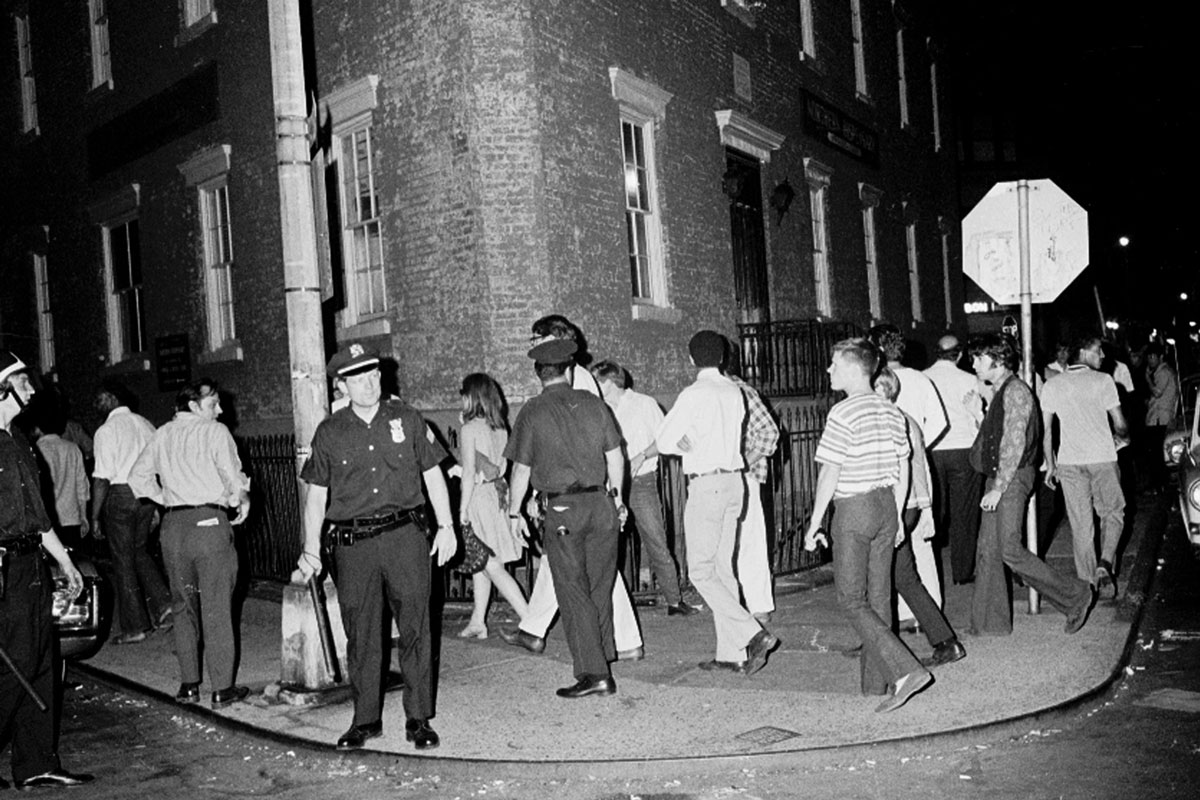
Despite the lull, queers remained in the streets—and another explosion was soon to come.
July 2, The Final Day of the Rebellion—On Identity, Vulnerability, and Riots
While the early nights of the rebellion and the days of lull had involved anger leavened with wit and cheerful banter, the mood had turned ugly by Wednesday night. Days of homophobic police occupation, injuries and arrests, mocking news coverage, and efforts by respectability-oriented activists to defuse anger engendered a cold fury among the crowds that assembled on the night of July 2. Likewise, the police were even more brutal: one observer noted, “The cops, who had been caught off-guard and were on the defensive before, had taken the offensive and massive retaliation was their goal.”26
By 10 pm, between 500 and 1000 people were seething in the streets. The arrival of a police motorcade to Christopher Street prompted a wave of shoving and bottle throwing. Shortly after, gay and trans/gender-nonconforming participants began to light fires in the street. The crowd discussed burning down the building housing The Village Voice in retaliation for its offensive coverage. Throughout the neighborhood, riot police attempted to snatch members of the crowd, who fought back fiercely, looting shops and smashing windows. A handful of people were arrested; a large number of people were injured, including some officers.27 Although the clash lasted a short time compared to earlier nights—the fiercest fighting lasted around an hour—its ferocity struck all onlookers. One participant concluded, “The word is out. Christopher Street shall be liberated. The fags have had it with oppression.”28
What makes a riot queer? One dimension involves the rupture of gendered expectations about who participates and how. Rioter Ronnie Di Brienza summed this up in a local paper a week later with an elegant audio metaphor: “Revolution is being heard on Christopher Street, only instead of guttural MC-5 voices, we hear it coming from sopranos, and altos.”29
The MC5 were a Detroit-based rock band popular among militant New Left activists and Yippies; their manager John Sinclair had founded the White Panther Party and worked with the anarchist newspaper Fifth Estate. On tour the previous year, the Motherfuckers had started a riot at an MC5 show at the Fillmore East, leading to the band’s being banned from a range of venues. By invoking the gruff swaggering masculinity of the MC5 and the street militants associated with them and contrasting it to the effeminacy of the frontline rioters at Stonewall, Di Brienza showed how the uprising not only asserted gay and trans grievances, but deconstructed the entire notion of who could be a revolutionary.
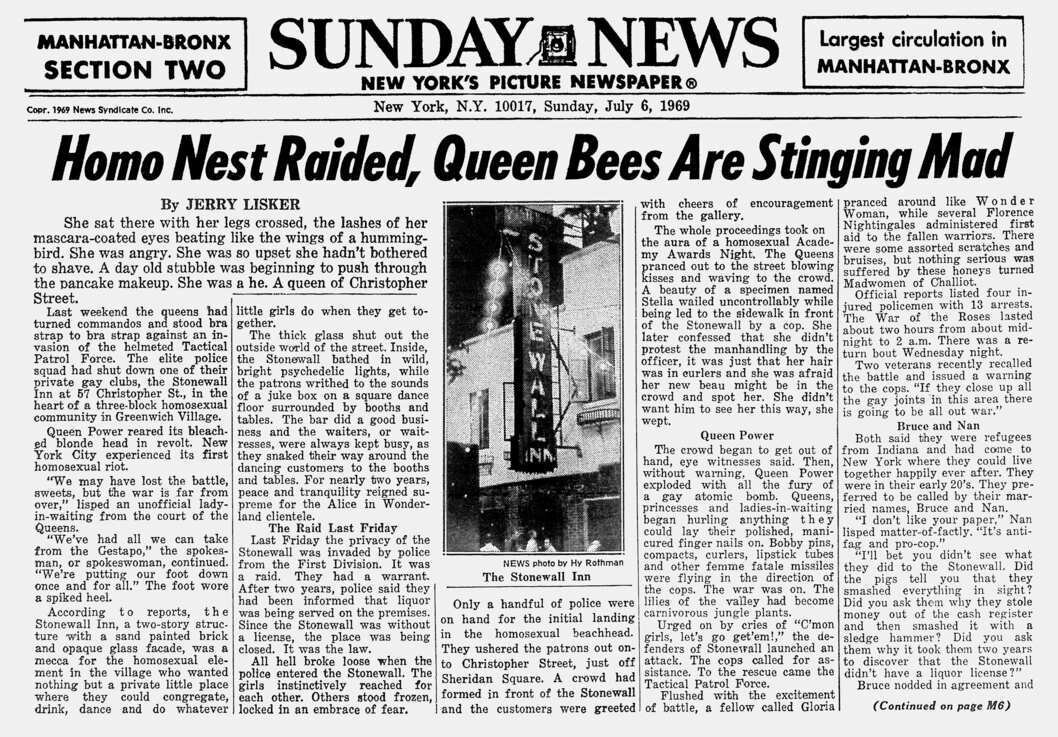
“Homo Nest Raided, Queen Bees Are Stinging Mad”—despite the mockery of local media, the effeminacy of the rioters stunned police and butch revolutionaries alike.
In the US today, many leftist commentators presume that people who are disproportionately vulnerable to state violence need to be sheltered from it in militant protest. This can lead to contradictory conclusions. Some assert that those insulated by some degree of privilege should take the front lines and actively participate in militant resistance in order to absorb the brunt of confrontations; others claim that those who have more privilege should refrain from participating in escalatory activity because its effects will disproportionately impact those who have less privilege. Critics of the latter approach respond that only by taking collective risks to defy state power can we do away with the conditions that render targeted communities vulnerable to state violence in the first place. Even well-meaning efforts to police the scope of militant tactics are generally premised on the patronizing assumption that targeted communities have no agency to resist on their own behalf. Ultimately, this framing supports the state monopoly on power.
These issues were the subject of strident debate surrounding the Stonewall Uprising, focusing most acutely on the night of July 2. Commentary on the final day of conflict focused on the demographics of the participants, and specifically the relationship between (presumably or predominantly) straight rioters from crews based outside the Village, such as the Motherfuckers and the Crazies, and the gay/trans/gender-nonconforming rebels in the streets. As Dick Leitsch from the Mattachine Society of New York observed shortly after,
The composition of the street action had changed. It was no longer gay frustration being vented upon unsuspecting cops by queens who were partly violent but mostly campy. The queens were almost outnumbered by Black Panthers, Yippies, Crazies and young toughs from street gangs all over the city and some from New Jersey. The exploiters had moved in and were using the gay power movement for their own ends. A lot of them were looking for a fight, and had the police not come, they probably would have started the old game of street gangs everywhere, “beating up a queer.” The blacks and students who want a revolution, any kind of revolution, were there to exploit. They swelled the crowd and tried to recruit, but “graciously” let the queens take all the bruises and suffer all the arrests. (If they have no more courage than they displayed on Christopher Street, their revolution is a long way off.)30
This narrative bears uncanny similarities to the accusations lobbed at (and within) many 21st-century North American social movements. An array of presumed outsiders—if white, coded as political radicals, and if Black, coded as apolitical criminals—are portrayed as a threat to whatever demographic is presumed to bear authentic political grievances and entitlement to local terrain. Note the invocation first of the Black Panthers and then of “young toughs” from “New Jersey.” It is almost certain that Leitsch did not interrupt rioters to ask them where they lived and that New Jersey residents were not visually identifiable as such. On the heels of the Black-led Newark riots of 1967, invoking “New Jersey” in contrast to the residents of the almost entirely white Greenwich Village neighborhood served as a racial code for white gay readers.
In an effort to prevent people from interpreting diverse participation in the rebellion as an expression of solidarity, Leitsch even concocts a fantasy of gay-bashing gang members so intoxicated by violence that they temporarily forget to attack gay/trans/gender-nonconforming people and instead attack the police alongside them. While anti-queer street violence was a reality in New York City at this time, Leitsch rejects the far more plausible explanation that a wide range of young people, including Black and brown kids, political radicals, and others, had suffered at the hands of the police and came together to fight back against them on account of shared interests and desires.
Observers who were more connected to the city’s marginalized communities and social movements, while noting the less visibly queer composition of the streets that night, arrived at different conclusions. Bob Kohler, a white gay radical and active supporter of the civil rights movement and the Black Panther Party, agreed that the crowd was different, but framed this in a broader context:
Yes, there was a difference in the makeup [of the crowd on July 2]. There were more people rioting that could not be easily categorized, and a lot of that had to do with people that came over from other areas. The straight movement moved in heavily that night as a support. I’m assuming it was as a support. They were, of course, using it for their own ends, too… You had, for lack of a better word, provocateurs who were seeing an incident that could be used for the good of their movement or a different movement or a coalition of movements. This was one more. It was the last. There was nobody else left to riot, so people with some foresight, more foresight than I [had] at the time, could see that this could again strengthen the radical movement, that people they hadn’t really thought about were now up there in the front. 31
Although referring to presumably non-gay rioters as “provocateurs” (while questioning his own use of the word), Kohler recognizes the broader participation in the night’s events as a form of solidarity oriented towards building a broader radical coalition that could resist the forms of oppression that multiple targeted communities experienced.
Neither activist specified how they knew that the rioters on July 2 were not “queens” or members of the gay community. For Leitsch, race certainly played a role, as well as gender presentation; to his credit, although not a “queen” himself, he insistently named and praised the role of effeminate gay/trans/gender-nonconforming people on the front lines of the uprising. Kohler was more familiar with the landscape of multiracial activism in the city; he may have recognized people from elsewhere. But both appear to have relied on a narrowly gendered, and to some extent racialized, interpretation of identity in reading the crowds.
At a time when gay identity was still publicly associated with effeminacy and functioned for many as a specific subculture with distinctive cultural styles, many homosexually active men did not register to other gay people as “gay” in a cultural sense. John O’Brien, a white gay left-wing activist who was present from the first night of the uprising, remarked that his more masculine presentation aroused suspicion that he might be a provocateur or police informant when he participated in gay demonstrations.
As one commenter on more recent queer riots has argued, one of the radical possibilities of street rebellion lies in how it can open up new ways of being in the world, weaponizing otherwise static identity categories as tools for revolt. We will never know exactly who comprised the crowd around Stonewall on July 2. Rather than asking who they had been, it might be more interesting to ask what they were becoming. Leitsch crafts a narrative in which the most marginalized members of a rebellious mass disproportionately bore the brunt of physical violence and legal consequences due to the combination of escalatory provocation and cowardice on the part of outsiders or more privileged participants. But there is another way to tell the story.
With the benefit of historical hindsight, it is clear that the participation of non-gay radical rioters in the Stonewall Uprising constituted a vital act of solidarity. By adding important tactical knowledge, swelling the crowds, helping to free arrestees, escalating and sustaining confrontational energy, and spreading word of the uprising beyond the confines of the Village, they helped to transform the events from a fleeting expression of long-suppressed rage to a rebellion with world-historical significance. Had the Motherfuckers, the Crazies, and other anarchists and rebels subordinated themselves to the prescriptions of contemporary identity politics and stayed home, the riots might have petered out sooner and with less impact. The Stonewall Uprising illustrates the meaning of the slogan solidarity means attack.
Setting aside the question of whether observers such as Leitsch and Kohler could infallibly read the sexual and gender identities of the rioters, we must ask—were those identities fixed and static? Should those identities have been primary in determining the rioters’ relation to the rebellion? Even in Leitsch’s paranoid fantasy of otherwise homophobic “toughs” temporarily turning to fighting homophobic police in order to slake their thirst for destruction—wouldn’t that be a good thing? Instead of “be gay, do crime,” the Stonewall rioters inverted the script: by doing crime together, regardless of what previous desires they felt or sexual subcultures they frequented, people across a wide range of identities made it easier to be gay. We might even say that they invented a new way to be gay together. What affinities, erotic and otherwise, might previously unconnected people have discovered in the streets? What new possibilities might the ostensibly heterosexual participants in the riots unlocked within themselves?
This destabilization of identity through revolutionary struggle became a hallmark of the emerging gay liberation movement, if only briefly. The earlier homophile movement’s major conceptual innovation lay in seeking civil rights for a “minority” by means of interest group politics. In that framework, a more-or-less fixed number of homosexuals existed alongside “other” minorities with their own distinctive issues (rarely, in those pre-intersectional times, did the implicit whiteness of this framework trouble white gay or lesbian activists). However, as one Gay Liberation Front activist explained in 1970 at a gathering of radical movements, gay people were coming to understand gay liberation not “as an oppressed minority fighting for rights but more the process of [creating] a society in which people can come out and be all that it’s possible to be” while rejecting “the false categories of homosexuality and heterosexuality.”32
At Stonewall, rioters put this into practice: rejecting the false categories that divided them, they fought side by side against the police who oppressed them, and in the process changed history.
On Outside Agitators and Militant Tactics
With the Fourth of July weekend pending, both gay residents and police anticipated that crowds would be massive and the riots would intensify. Riot police continued to assemble in the Village, redirecting their attention from the Motherfuckers’ usual rebellious turf, as a local left-wing newspaper observed:
The calling in of the TPF had the incidental benefit of taking the heat off the Second Avenue and St. Marks Place area of the Lower East Side, the TPF’s usual stomping grounds, allowing street people there an unusually relaxed July 4.33
However, although large numbers of people assembled in the streets of the village and sporadically confronted police, major clashes did not break out. As Leitsch described the following days:
Sporadic efforts were made to start trouble—by people who can best be described as “outside agitators,” by gay people, and too often by uptight cops who tried to start trouble to give them an excuse to start bashing heads again. Despite those efforts, no major outbreak erupted. It was almost as if everyone had decided that the point had been made and any further action would only bring on a backlash.34
It is not surprising that Leitsch, as a white moderate, adopted the “outside agitator” language first deployed by white supremacists in the South against civil rights and labor organizers and later generalized to target all forms of protest. During the civil rights struggles of the early 1960s, this language was so widespread that Dr. Martin Luther King, Jr. spent much of his “Letter from a Birmingham Jail” addressing it.
Following another half century of seeing this language weaponized to divide and discredit radical social movements, it is easy to recognize such rhetoric as purely reactionary. We should understand that Leitsch’s subsequent accounts of the uprising were shaped by his experience of being marginalized by the younger and more radical participants. Rejecting his attempts to position his own organization, the Mattachine Society of New York, as the head of the gay movement in the uprising’s aftermath, radicals went on to found the Gay Liberation Front, which continued to pursue a confrontational approach and worked to form alliances with precisely the radical groups Leitsch had condemned as “outside agitators.”
Bearing this in mind, let’s consider Leitsch’s description of the looting that unfolded on the night of July 2:
Obviously, little of it was done by people who live in and frequent Christopher Street and environs, because all the most unlikely places were looted. The first shop to get hit was the “Gingerbread House,” a toy shop run by a delightful little lady who is a friend of everyone on Christopher. The other shops broken into were also run, for the most part, by nice people, sympathetic to the gay cause and the plight of the street queen. The really likely places, the “fag shops” that overprice their wares and bleed the gay market for exorbitant prices, were left alone. Shops whose managers complain the loudest about the cruising and swishing in the neighborhood were also, surprisingly, left alone. Observers in the know doubt if the looting was done by gay people.35
Leitsch did not condemn property destruction or looting out of hand; rather, he criticized the looters for the specific targets they chose. His response includes a critique of the economic exploitation of the gay community and the petty bourgeois norms of respectability preached by business owners. While stopping short of validating property destruction as a tactic in service of these critiques, he cites the pattern of which businesses were attacked as evidence that looters lacked intimate knowledge of the neighborhood’s gay geography and the grievances that might prompt radical action.
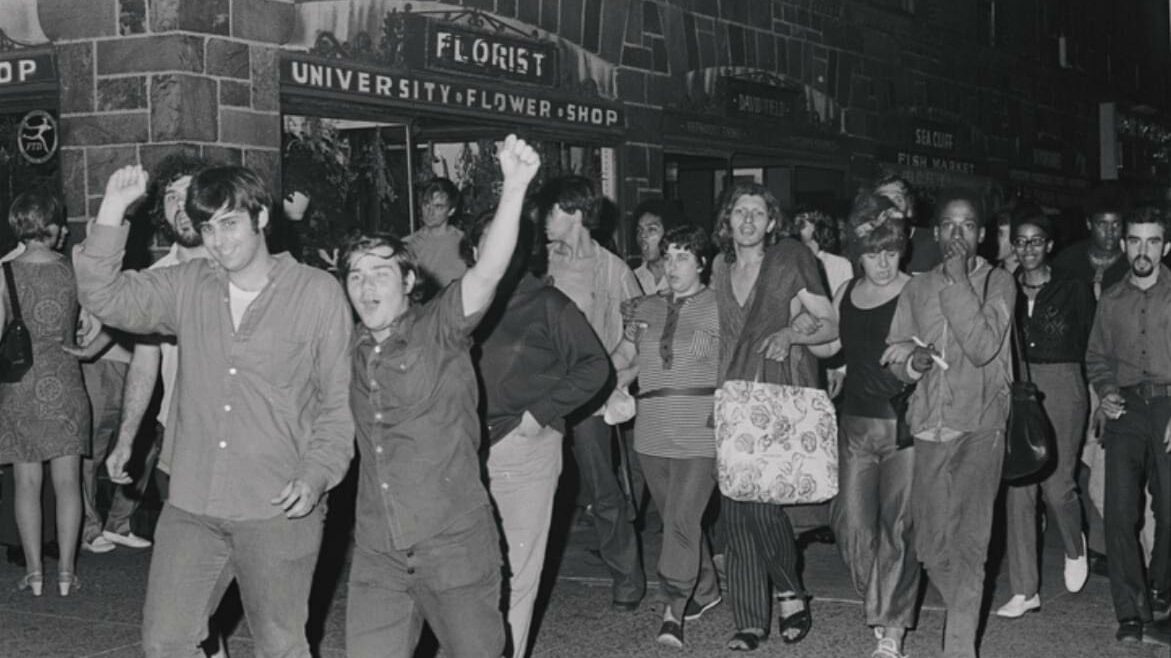
Queer rioters’ intimate knowledge of the West Village helped to sustain the revolt.
Leitsch’s critique anticipates the debates over property destruction and “diversity of tactics” that have saturated the anarchist movement over the past three decades—particularly during the mobilizations of the so-called anti-globalization era, from Seattle to Miami to Adams Morgan. On occasion, anarchists who have become exasperated with these debates have dismissed valuable good-faith critiques of confrontational actions. Perhaps, had the Motherfuckers and other rebels who converged on Stonewall taken the time to confer with local gay residents, they might have been able to pick their targets more thoughtfully, thereby achieving an even more seductive riot.
But was Leitsch’s representation of the looting of July 2 accurate? Lacking other sources that comment directly on which businesses were attacked and how, it is difficult to say. His rhetoric reflects a common pattern in moderate critiques of property destruction during times of widespread unrest. Knowing that the rebellion was widely popular and reflected deeply felt anger, Leitsch identified the righteous fury that queer residents felt at their economic exploitation, at the scorn targeting femme and gender-nonconforming people, and at the repression of cruising and public sex—but he attempted to redirect some of this fury against imagined “outsiders.”
Perhaps, then, we should not uncritically read the looting as poorly targeted militant action, but as an expression of outrage so popular that it forced even committed opponents of militant action to frame their critiques as a matter of targets, not tactics. Today, we need not look far to find pundits eager to defuse and recuperate popular anger by praising “our right to resist” in the abstract while criticizing every concrete action as the wrong place, the wrong time, the wrong target.
Leitsch himself and other homophile groups had been organizing for years without qualitatively shifting the sense of possibility in the Village or beyond. Without downplaying their accomplishments, which included a significant decrease in police harassment and entrapment from 1966 forward, we can see that it took a dramatic break with existing forms of activism and the norms governing queer people’s relationship to public space to make the quantum leap into the era of gay liberation. Only by defying the demands of city officials, police, and established gay activists—by remaining in the streets and fighting back over an entire week while refusing to accept the tactical limits that leaders attempted to impose—did young queer people and their comrades render a deeper shift possible.
Whatever so-called “outsiders” participated in the rebellion, it is clear that the gay, trans, and other assorted members of the community around the Stonewall were ready to embrace more militant tactics. As Ronnie di Brienza, a self-described freak who participated in the first night’s riot, put it:
I have had a lot of shit thrown my way, but until Friday night, June 27, I was basically a pacifist. However, pacifism is fast going out the window. How many times can one turn the other cheek. There is a limit, and Friday night was it… Poof, it starts. The fags have gone revolutionary… The fags, like the true revolutionaries, have become resigned to fighting for their cause, if necessary by force and with heavier weapons.36
Members of the established homophile groups reacted with ambivalence to the militancy of the riots, which many younger gays saw as a harbinger of their irrelevance. The Insider, the newsletter of the Mattachine Society of Washington, exemplified this discomfort in their coverage of the riots:
The Insider does not see this exhibition of militancy as a fluke. Militant open defiance has become the most characteristic mark of the sixties’ protest movements. First used by the blacks in irrational riots, and later used more systematically by hippies and campus protestors who shut down their own universities, militancy has never been characteristic of the homophile movement. Militant protestors rationalize their destructive methods by pointing out that knocking on doors is useful only to a point. When it becomes clear that the doors are never going to open and that door knocking is only a pacifier for the masses, then it is time to knock the doors down. In these terms, the homophile movement is behind the times. It is quite possible that the homosexuals in the streets may well make obsolete much of what the present homophile is doing. For better or worse, militancy is here.37
The conventional racist characterization of Black revolt as “irrational” and anxiety about the “destructive” methods of militants reflected the racial, class, and generational positioning of many homophile activists. Self-described “gung-ho right-winger” homophile activist Foster Gunnison, Jr. lamented, “It is common knowledge that the Commie-pink-anarchist fringe tries to take over any minority cause it can latch on to, and for us it had to come sooner or later.”38
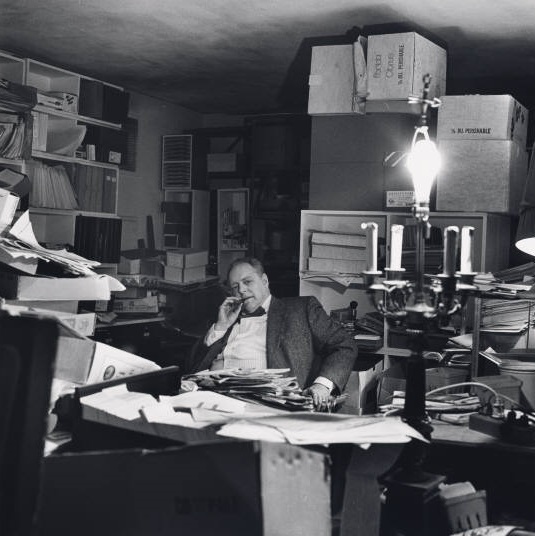
Conservative homophile activist Foster Gunnison, Jr. condemned the “Commie-pink-anarchist fringe.”
While less reactionary, Don Jackson of the Los Angeles Advocate scolded the rebels and urged activists to rein them in:
Homosexuals simply cannot afford rioting and violence. Such incidents solidify straight opinion against them and will surely bring a reaction… It is essential that rational leaders appear who will redirect the anger into more peaceful and successful methods. Otherwise, history and sociology indicate, gay riots on a vast scale with needless loss of life and property damage may occur. This is not the road to equality. Such disturbances will increase the irrational hatred the straights feel toward homosexuals. Every educated reasonable member of the gay community must aid in redirecting the anger and frustrations of the more violent and emotional members.39
In historical hindsight, Jackson could not possibly have been more wrong. In fact, the rioting and violence at Stonewall catalyzed an international militant movement that helped transform the lives of millions of queer and trans people, and remains better known and more widely praised than any other act of protest or resistance in United States LGBTQ history. Yet today, self-proclaimed leaders across a wide range of communities persist in saying the exact same thing.
Others, however, broke free from the constraints of homophile timidity and enthusiastically embraced the riots. Jack Nichols and Lige Clarke, a prominent gay activist couple who had participated in Mattachine organizing since the mid-1960s, penned a column in Screw that offered a full-throated endorsement of militant gay resistance to police:
The revolution is taking to the streets, and it is high time that it did… We were thrilled by the violent uprising in Sheridan Square in which homosexuals put police on notice that they’d no longer accept abuse. For many decades gay people have been afraid to stand up for themselves and have allowed policemen to run over one of their most basic civil rights: the right to assemble in public. Today, however, a new generation is angered by raids and harassment of gay bars, and last week’s riots in Greenwich Village have set standards for the rest of the nation’s homosexuals to follow.40
Over the years that followed, Nichols and Clarke continued to radicalize, while remaining critical of authoritarian leftists who they described as “just as unbalanced on the gay issue as is the far right. Gays get it from both ends, so to speak.”41 By the 1990s, Nichols would be authoring a column titled “The Homosexual Anarchist.” Through the crucible of Stonewall and gay liberation, some homophile activists developed a far more radical critique of the existing world.
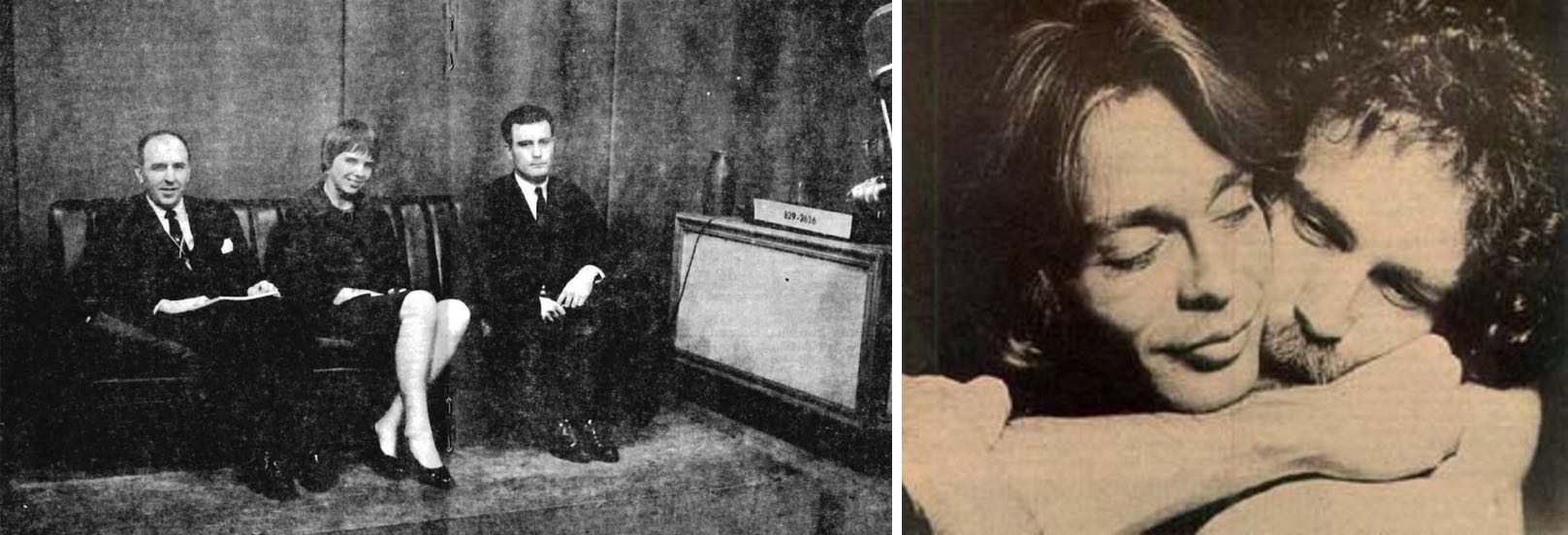
Jack Nichols: from polite homophile… to “homosexual anarchist.”
Anarchism, Affinity Groups, and the Gay Liberation Front
The energy unleashed by the Stonewall Uprising produced a wave of organizing that quickly rendered the existing gay activist infrastructure irrelevant. Under pressure from fired-up radicals, Dick Leitsch agreed to form a Mattachine Action Committee, and flyers circulated for a meeting on July 9, one week after the last night of rioting. Around a hundred people, mostly younger gay and lesbian radicals, turned up and made plans to organize a march against police harassment.
At the next meeting, a week later, the young radicals made a definitive break with the old guard. When Leitsch attempted to lecture the angry crowd about the importance of pursuing progress slowly via accommodation with the straight establishment, Jim Fouratt denounced him:
“We have got to radicalize, man! Be proud of what you are, man! And if it takes riots or even guns to show them what we are, well, that’s the only language that the pigs understand! All the oppressed have got to unite! The system keeps us all weak by keeping us separate.”42
His speech received wild applause. Leitsch’s attempts to regain control of the meeting failed. The radicals agreed to form a new organization that would sustain the energy of the Stonewall Rebellion. This became the Gay Liberation Front (GLF).
Over the years since, the GLF has often been described as “anarchic” or “anarchistic,” but little attention has been paid to the role that anarchists and anarchist ideas in its founding. The founders who assembled in late July 1969 at Alternate U were radicals from across the left-wing spectrum. As Karla Jay recalled, the crowd of around forty at the first meeting included “drag queens, bar dykes, street people, feminists, radical students, leftists, socialists, Marxists, Maoists, anarchists, libertarians, hippies, and former Yippies.”43 As gay liberation organizing blossomed across the city over the following years, regardless of whether its participants used the language of anarchism to describe themselves, the movement relied on anarchist infrastructures, engaged with anarchist concepts and tactics, and adopted a distinctly anti-authoritarian ethos.
The location of the GLF meetings is revealing. Alternate U was a radical educational project that hosted a wide range of workshops and teach-ins, classes on a variety of radical topics, social and cultural events, and activist meetings. Located on the second floor of a warehouse at West 14th Street and 6th Avenue, it sat on the northern edge of the West Village, a short walk from Stonewall and the core of the gayborhood where the riots had occurred.
Founded in 1965 as the Free University of New York, as the Interference Archive explains, it had been launched as “a free university, with no exams or degrees, where they could learn about social struggles and everyday life,” whose participants “strove for a revolutionary experience in education.” By 1969, it had changed its name to Alternate U and was attracting participants from a wide range of movements, from radical psychologists to media collectives to women’s theater groups. The project was coordinated by a collective of radicals that included anarchists and Marxists; the space hosted the Anarchos Group and featured talks by Murray Bookchin and other anarchist thinkers.
Stonewall rioter John O’Brien—a Marxist who had been expelled from the Socialist Worker’s Party’s Young Socialist Alliance for his homosexuality—served on the project’s board; this provided the initial connection that helped enable the GLF meetings to find a home there. After the GLF’s founding meetings in the space in July 1969, Alternate U continued to host many of the group’s activities, including their gay dances, the most popular and widely attended GLF project. The weekly gatherings offered the first public alternative to Mafia-controlled bars at which same-sex couples and trans/gender-nonconforming people could dance freely; this, in turn, provided a critical source of revenue for the fledgling group. Holding meetings and dances at Alternate U brought a wide cross-section of activists and the gay population at large into contact with anarchist and radical ideas.
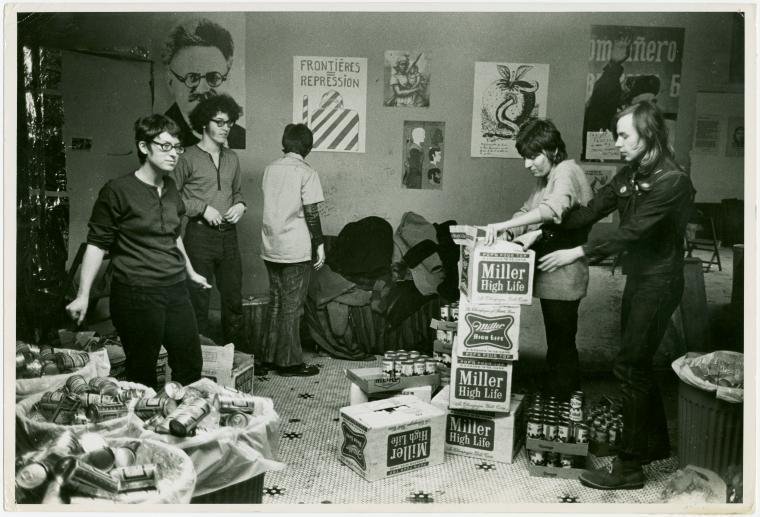
GLF members prepare for a gay dance at Alternate U, 1970. A poster from the May 1968 uprising on the wall behind them reads “Borders = Repression.” A message for all movements based around identity.
Political differences emerged within the GLF from the beginning, but a loose anti-authoritarian consensus determined the organization’s structure and culture. A political scientist who interviewed many of the group’s members and offered the closest early reading of the group’s politics characterized the GLF as dominated by “radicals” who “championed anarchy.” These participants coexisted with doctrinaire “revolutionaries” who “looked forward to socialism,” with whom the radicals sometimes collaborated and sometimes found themselves at odds.44
These values were reflected in the group’s decision-making practices. According to an observer of the early meetings, “When a decision had to be made, voting was unpopular. After sufficient discussion, a “consensus” was arrived at—the membership, undivided, coming to an agreement. Time-consuming often, but solidarity-building.”45 There were no officers and no formal leaders, though informal hierarchies did solidify around those who were popular, perceived to have revolutionary cred, or sometimes, as critics noted, simply spoke loudly. While the exhilaration of being together exploring radical ideas carried the participants through the early meetings, as more political differences surfaced, clarifying the group’s structure and priorities became urgent.
Most of the participants in the GLF were gay men, but a few lesbians played prominent roles. One of them was Lois Hart. In her thirties, Hart was older than most members; she had left her life as a nun to explore lesbian identity, radical politics, and alternative spirituality. In the months before Stonewall, she had participated in courses on feminism and anarchism at Alternate U, where Murray Bookchin had spoken about anarchist organizing and affinity groups.46
In the fall of 1969, Hart proposed that the GLF adopt a decentralized structure in which the GLF weekly meetings would serve as spaces for autonomous groups to report on their activities and coordinate efforts, while individual cells retained the freedom to work on projects independently.47 The group agreed to adopt this anti-authoritarian structure; separate clusters formed to organize the weekly dances, publish the newspaper Come Out!, study gay oppression through a Marxist lens, and pursue other goals.
John Lauritsen, who brought a dogmatically Marxist approach to gay organizing, dismissed the cellular structure as “some Murray Bookchin inspired notion.”48 Indeed, Bookchin had been a direct influence on Hart through Alternate U. As a gadfly critical of the authoritarian turn of SDS and the New Left, Bookchin represented an anarchist alternative that appealed to many in the feminist and gay liberation movements who were critical of traditional organizing models.49
Over the following year, fifteen cells developed under the auspices of the GLF. Some eventually broke away to become fully autonomous groups, including Third World Gay Revolution, Gay Youth, and Street Transvestite Action Revolutionaries.50 Some of these groups outlived the GLF itself, which ceased to function by early 1972. While the GLF proved short-lived, its influence rippled out across time and space, as the model of horizontal autonomous organizing based in cells and affinity groups generated new collectives and spread around the country.
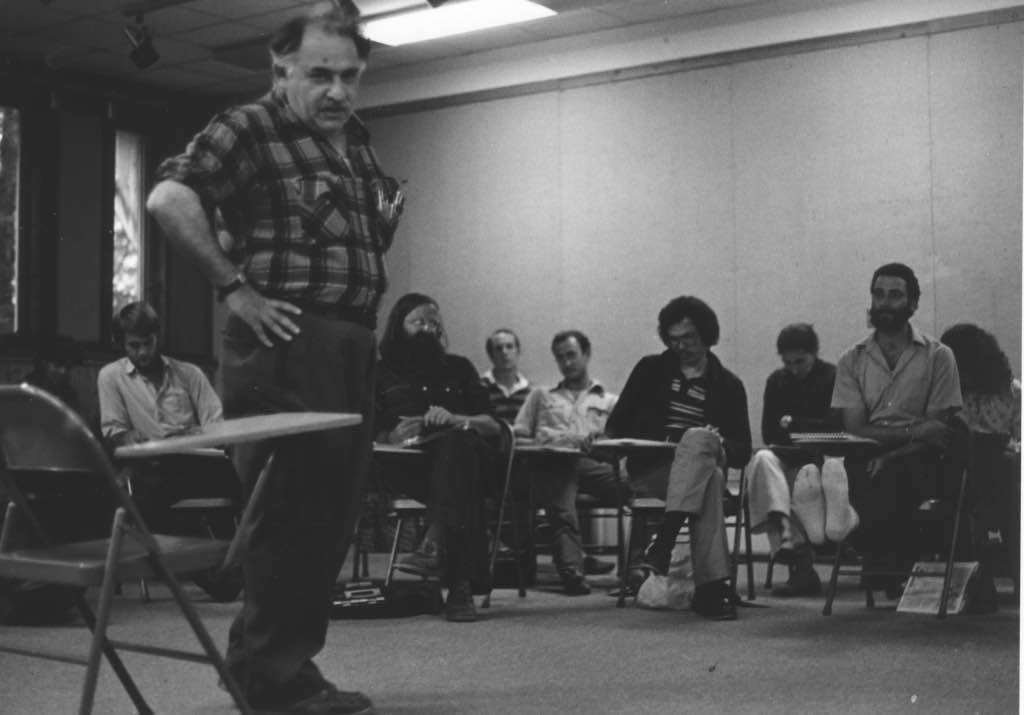
Murray Bookchin, who helped translate the concept of affinity group organizing from anarchists in the Spanish Revolution to the GLF’s cell structure.
GLF participants reflected critically on the model as it unfolded, arriving at different conclusions about its efficacy. In January 1970, Hart explained in the GLF newspaper Come Out! that “the many mentalities, dispositions, and persuasions of GLF activists and dissenters are finding expression in small groups structured after the needs, goals and philosophies of the participants.” The cell structure, she explained, reflected a commitment to direct action and active participation that necessarily required breaking with the conditioning into passivity that hampered radical movements: “In the knowledge that growth and change occur within individuals and that individuals develop only through active involvement in projects and goals of their own choosing, GLFers chose the rocky road of fluid cellular organization rather than perpetuate older, oppressive structures of Follow the Leader and passive participation by voting.”51
As the group grew, attracting a wider range of participants beyond its initial radical core, some who were accustomed to more centralized forms of organizing became frustrated when they could not dictate the activities of the entire group according to their own ideological or tactical preferences. This became particularly pronounced with the arrival of more “well-meaning establishment types who could not conceive of something democratic that did not involve everyone being controlled by the consensus of a voting membership.” As Hart explained, “For them GLF was the Sunday Night Meeting, not groups of activists for homosexual liberation. They did not realize that we are a movement, not a static organization.”52
Those of us who participated in the Occupy movement may smile with rueful recognition here.
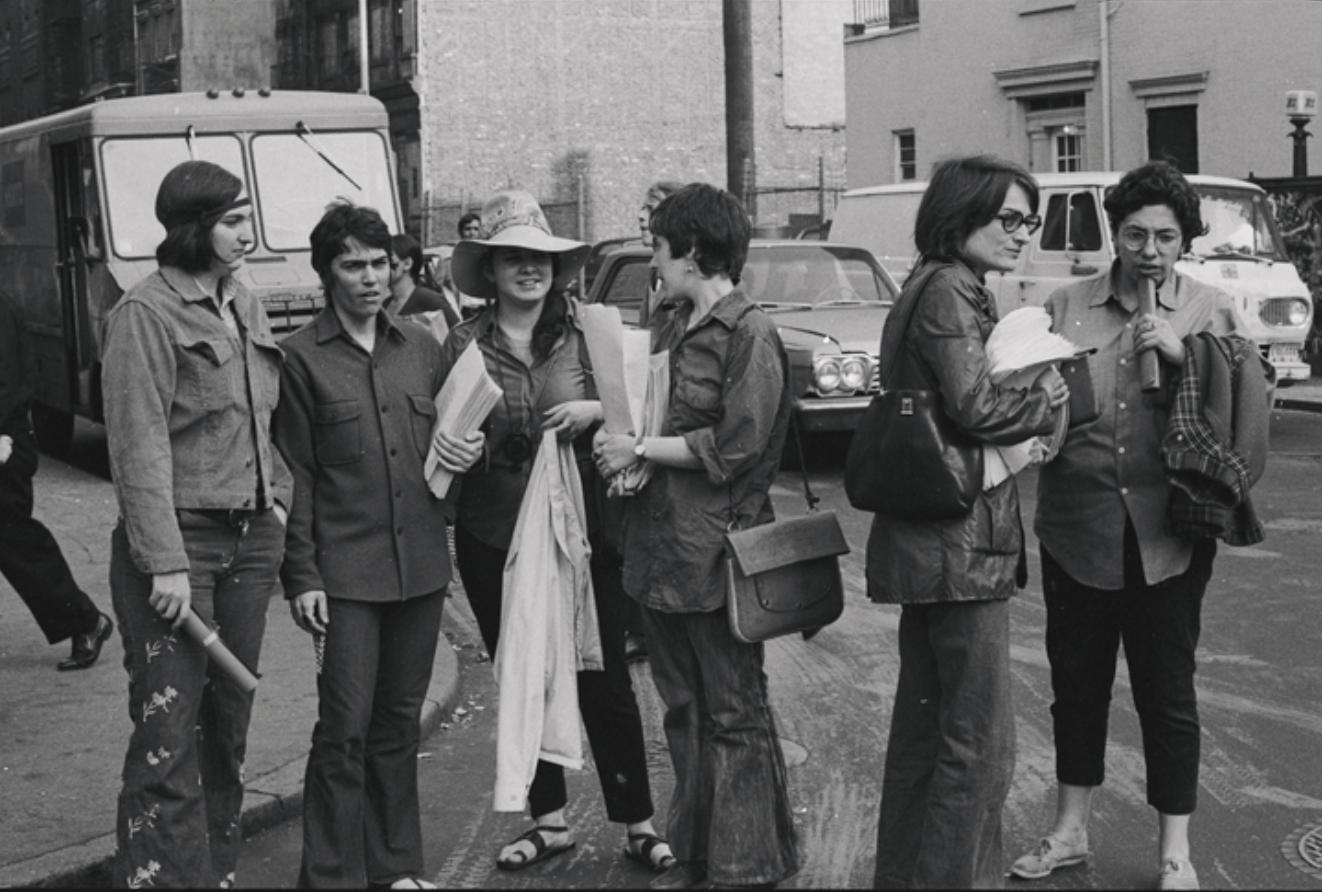
Lois Hart (second from right) prepares to participate in a “Lavender Menace” action at the Second Congress to Unite Women with her fellow Radicalesbians, May Day 1970.
Not all participants agreed that the flexibility and autonomy of the cell structure served to build the movement for gay liberation—indeed, not even all of the anarchist participants did. One such critic, Arthur Evans, became famous in the late 1970s for his book Witchcraft and the Gay Counterculture, which called for a gay anarchist revolution in which decentralized affinity groups would use witchcraft and direct action against patriarchy and the military industrial state. In 1970, however, his frustration with the group’s chaotic structure and dispersed focus led him to join with others seceding from the GLF to form the Gay Activists Alliance, a resolutely single-issue organization with a more traditional structure.
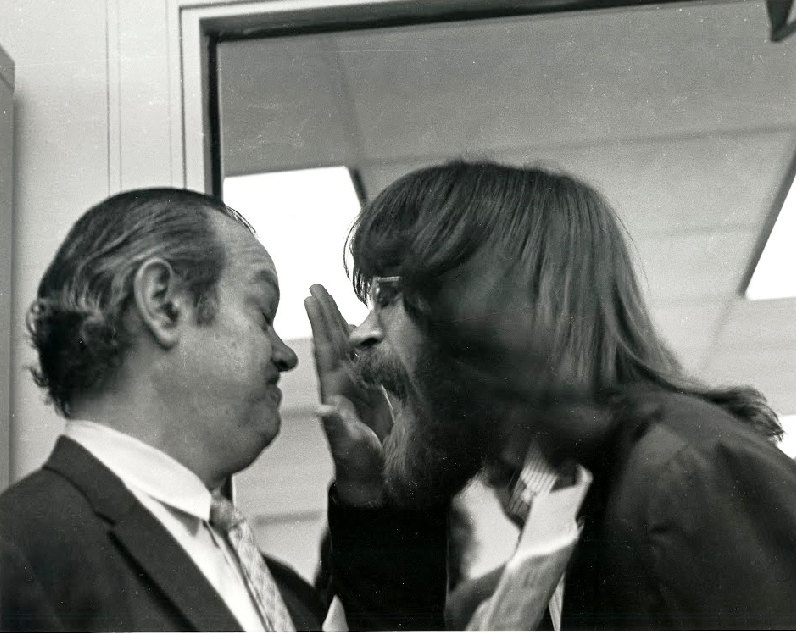
Arthur Evans lets the straight world know exactly what he thinks.
Ralph Hall, an artist who was to author a series of gay anarchist zines in the following years including Faggots and Faggotry and Revolutionary Limpwristed Faggot, wrote in late 1969 that the GLF’s “structureless structure” granted too much power and influence to unscrupulous authoritarians. Criticizing the members of the 28th of June cell, which took over the publishing of Come Out!, as “a flighty crop of revolutionary dogmatists,” he took them to task for glorifying authoritarian communist regimes (“What does the sexual revolution in Cuba have to do with homosexual oppression in Amerika?”) and for taking advantage of the loose consensus process to “shrewdly manipulate and brainwash the membership.”
“I thought,” Hall lamented, “we had no leaders or followers, but all participants.”53
Despite the challenges of the cell structure and participants’ internal critiques, the model spread to other cities. Dozens of GLF chapters appeared across the country over the following months; while not all of them modeled their internal structure on the New York group, many did. As NYC GLF participant Bill Weaver recalled, “There was a real struggle to establish cells. New York went through this ‘cellular’ struggle, and now, when Washington GLF or Walla Walla GLF has it, they assume at the very beginning that they’re going to have cells.”54
The Washington, DC GLF’s adoption of the cell structure proved influential far beyond its members—indeed, beyond the entire gay liberation movement—because of the role its participants played in what was to be the largest mass mobilization in US history up to that time, the 1971 May Day protests.
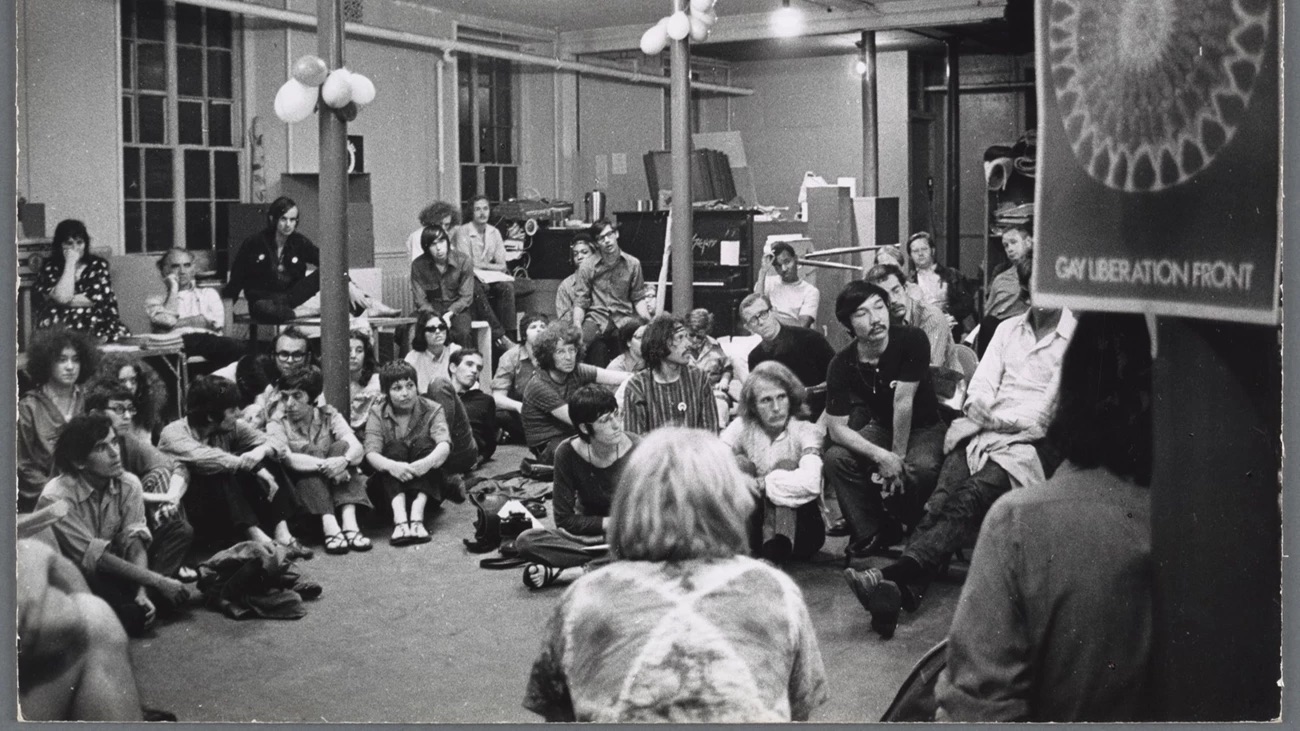
A Gay Liberation Front meeting at Alternate U in 1970.
Gay Mayday 1971: A Queer Genealogy of Affinity Groups at Mass Mobilizations
The centrality of gay organizing within the 1971 May Day anti-war mobilization did not come out of nowhere. From its inception, the nascent gay liberation movement had overlapped with the movement to end the US war in Vietnam. The pre-Stonewall homophile movement had largely remained silent on the war, while advocating for an end to the US military’s ban on homosexual service members. By contrast, gay liberationists donned T-shirts reading “Suck Cock to Beat the Draft,” joined anti-war marches, and, according to an account from the notorious queer performance troupe The Cockettes, hung out outside of military induction centers offering blowjobs to draftees in order to help them secure deferrals.
After Stonewall, members of the newly formed GLF took an active role in the anti-war movement. The first non-gay-organized action that members participated in with the GLF banner was an anti-war, anti-draft protest late in the summer of 1969 at Central Park. Television cameras circulated images of the group’s members and materials nationwide.55
“Through a lot of 1970,” recalled Perry Brass, a member of the GLF cell that produced the newspaper Come Out!, “I must have gone to at least six different antiwar marches where we [gay people] were all joining hands and marching up Fifth Avenue or marching in the park.”56 In the months following Stonewall, gay liberationists in California circulated a flyer riffing off of a famous quote from Muhammad Ali, titled, “No Vietnamese Ever Called Me a Queer.” The flyer advertised a performance by the Berkeley-based Gay Liberation Theatre, putting both the US military and the homophobic anti-war movement on notice:
So we’re not going to fight in an army that discriminates against us, fucks us over, sends us to the front lines or jails us and throws us out dishonorably when we are ourselves and love our brothers. Nor are we going to fight for a country that will not hire us and fires us when we are ourselves and loving our brothers, that puts us out of and puts us down in every phase of its every institution. Nor are we going to fight in a revolution that puts us down.
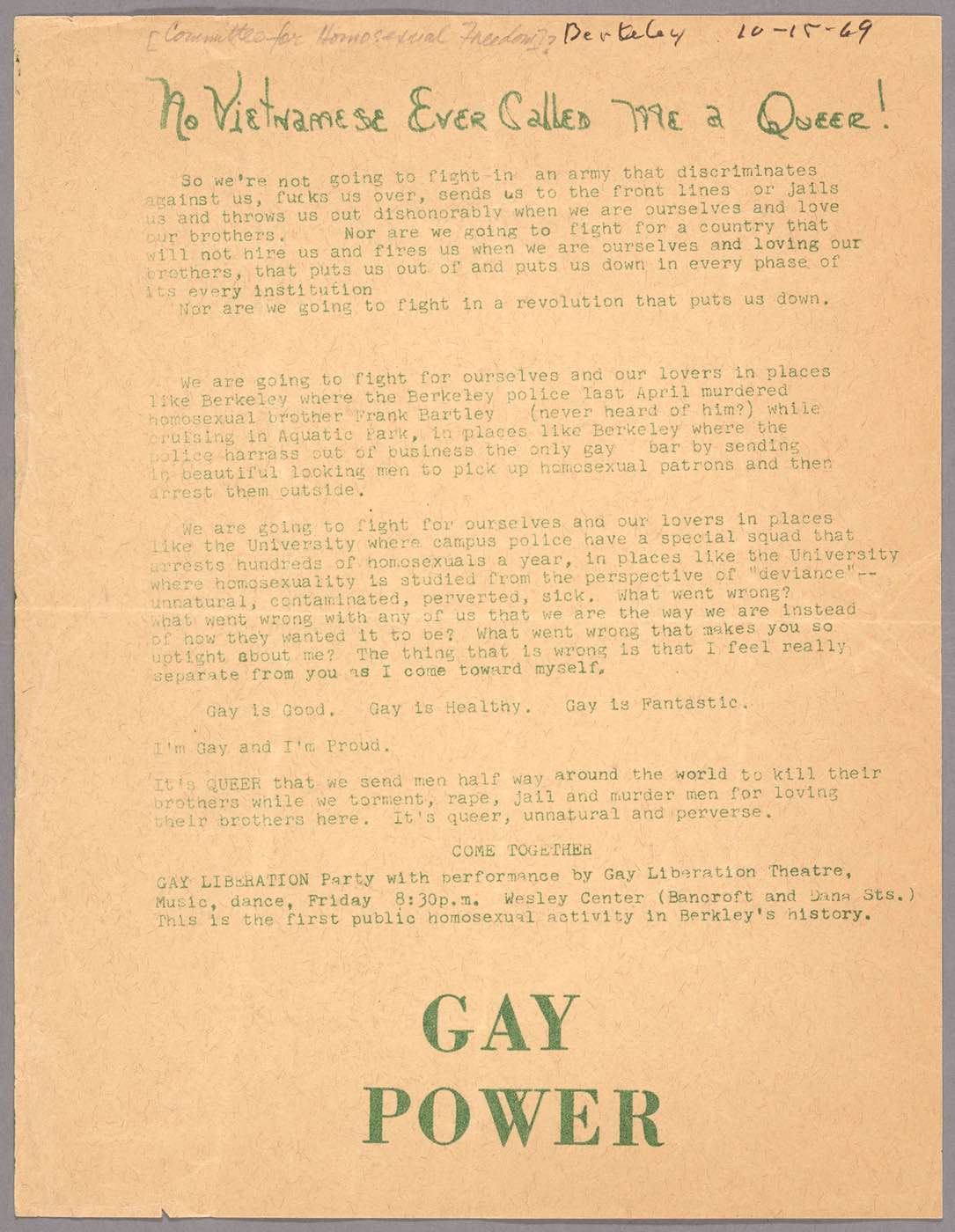
“No Vietnamese Ever Called Me a Queer.”
As the gay liberation movement blossomed in 1970, activists in the anti-war movement were beginning to question their model of holding mass marches in Washington, which attracted large numbers of participants and ample media attention but appeared to have little impact on the war machine. In fall of 1970, a range of anti-war groups assembled under the umbrella of the People’s Coalition for Peace and Justice began coordinating plans for actions in the nation’s capital the following spring. While members of the PCPJ timed a lobbying week for the end of April to plead with politicians to end the war, more radical participants assembled in an informal coalition dubbed the May Day Tribe, including a range of Yippies, anarchists, and other radical protesters determined to shut the city down. The May Day Tribe adopted the slogan, “If the government won’t stop the war, we’ll stop the government.”
As the mobilization approached, a small core of DC-based activists who staffed the office and worked on coordinating logistics for the demonstration began calling themselves the Gay Mayday Tribe. Participant John Scagliotti recalled, “There were about five of us who were gay, and we sort of ran the office. We immediately became very close and out of that was Gay Mayday.”
The group functioned partly as a political collective, partly as an underground cell undertaking a range of illegal activity, and partly as a polycule—with participants organizing, partying, and sleeping with each other. At a time of rampant FBI infiltration of radical groups, the Gay Mayday crew remained impervious to snitches because of its emphasis on queer sexual as well as political affinity. As Scagliotti explained, “They couldn’t infiltrate it, because we were all sleeping with each other. And we were doing a tremendous amount of illegal things, that they could have gotten us all for.”
Be gay, do crime indeed!
Like the Stonewall rioter who analyzed the roots of homophobia in the threat that gay men posed to a social structure based in rigid masculinity and the nuclear family, the DC organizers framed gay opposition to the war not in a paradigm of identity politics, but in a broader analysis of how patriarchy, capitalism, and imperialism form a single interlocking system. As L.A. Kaufman explains:
The Gay Mayday Tribe viewed its participation in the 1971 antiwar action as more than just a matter of mobilizing gays as a constituency or contingent, along the lines of “schoolteachers against the war” or “physicians for peace.” Instead, it sought to draw connections between militarism and social constructions of gender. One Gay Mayday leaflet called the Vietnam War “a straight man’s game,” created by “men who need to gain their masculine identity through the killing of women, children, and their own brothers.” A call to participation elaborated, “We know that the men running the country are very deeply sexist—they relate to each other and to situations in an uptight straight male way. These men make decisions in order to satisfy their male egos and their needs for competition with other men.” The Gay Mayday Tribe offered up an expansive radical vision, in which gay liberation could not only transform laws or lifestyles, but also undermine the very foundations of war. For, they promised, “an army of lovers would not fight.”
The loose collective included members of the Washington GLF, which had adopted the New York group’s horizontal cellular structure. Kaufman attributes the GLF’s structure to the influence of the women’s liberation movement: “The radical feminist influence was also felt in the GLF’s ‘structureless’ organizational form, comprised of decentralized collectives (called, in this case, ‘cells’) with no formal decision-making process, membership requirements, or bylaws.” While Lois Hart, whose proposal had played a significant role in shaping the GLF’s structure, was certainly a feminist and active in the women’s movement, Hart also named anarchist ideas, in particular the notion of affinity groups emerging from the Spanish anarchist movement conveyed via Murray Bookchin, as central in shaping her approach to revolutionary organizing.
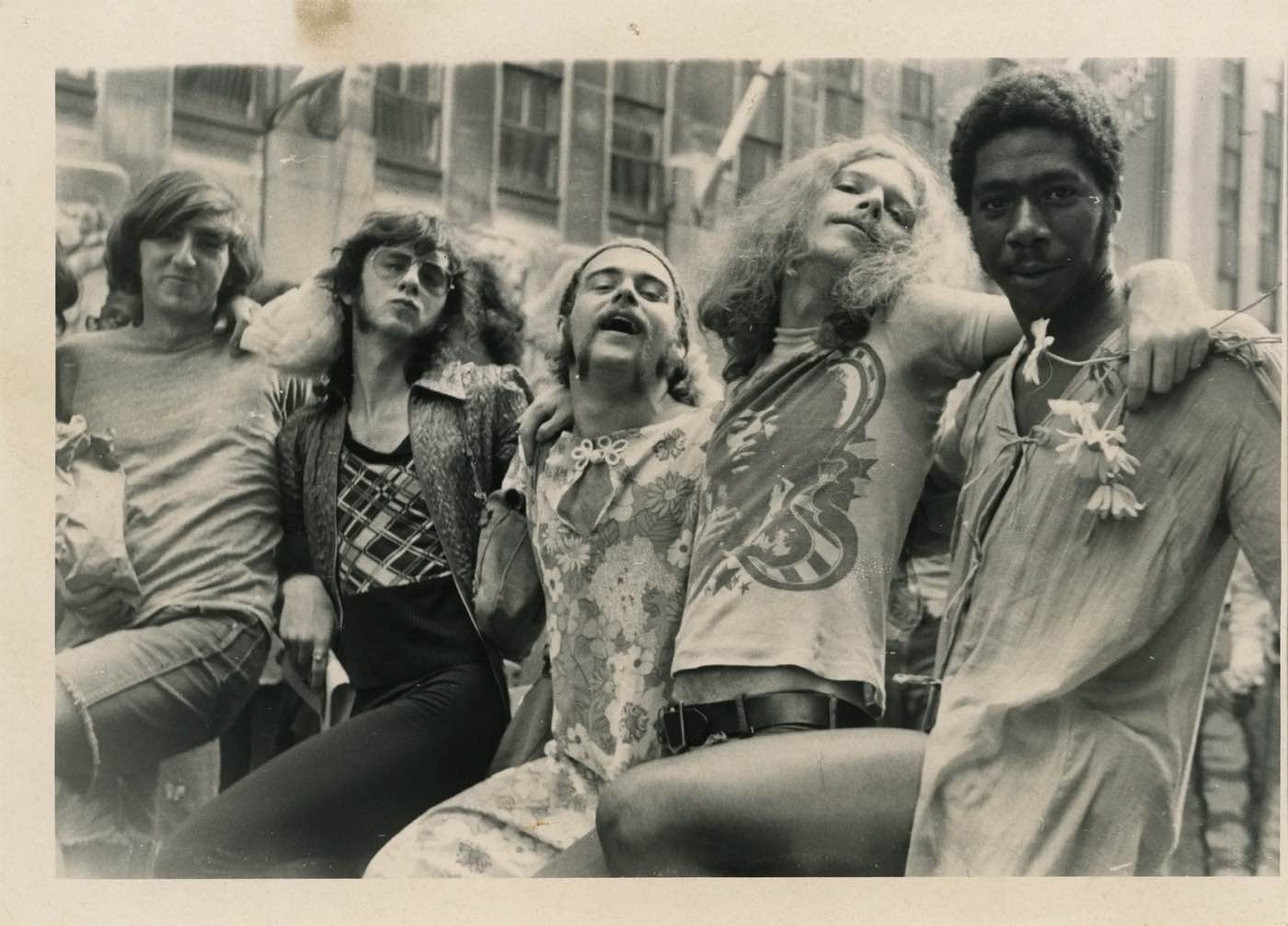
Members of the Washington, DC Gay Liberation Front, 1971.
The GLF’s approach represented one of the two major influences on the affinity group structure adopted in May 1971. The other had reached the New Left via the Motherfuckers. Kauffman connects the dots:
Morea and the Motherfuckers soon introduced the idea of affinity groups as teams for street combat to Weatherman, the faction of SDS that aspired to be a revolutionary fighting force and to “bring the war home” to the United States. It was during the October 1969 “Days of Rage,” perhaps Weatherman’s most notorious action, that affinity groups made their true American debut.
The Days of Rage had turned out disastrously, owing in part to the centralization and authoritarianism of the Weatherman leadership. Yet activists who rejected vanguardist militarism but remained intrigued by the possibilities of decentralized and mobile formations at mass demonstrations revisited the approach in the 1971 organizing. As Kauffman summarizes:
By the time the Mayday Tribe put out its call to protest, the concept of affinity groups had begun to blend with the other small-group forms that were rapidly growing in countercultural popularity: collectives, communes, cooperatives, consciousness-raising groups. “Affinity groups at Mayday,” recalls John Froines, another Chicago 7 defendant centrally involved in the action, “were both a tactical approach in terms of the street and also something more, connected to people’s linkages to one another.”
In an effort to prevent the demonstrations from completely paralyzing Washington, DC, police and National Guard troops mass-arrested 12,000 people across three days of disorder—the largest mass arrest in US history. In addition to partially shutting down the city and damaging the Nixon administration’s standing, the format of decentralized affinity groups acting autonomously in coordination with each other proved enormously influential. Afterwards, it remained the preferred means of organizing mass direct action from the anti-nuclear movement of the 1970s to the queer-led civil disobedience of ACT-UP (the AIDS Coalition to Unleash Power) in the 1980s to the global justice movement that exploded onto the world stage with the protests that shut down the Seattle summit of the World Trade Organization in 1999.
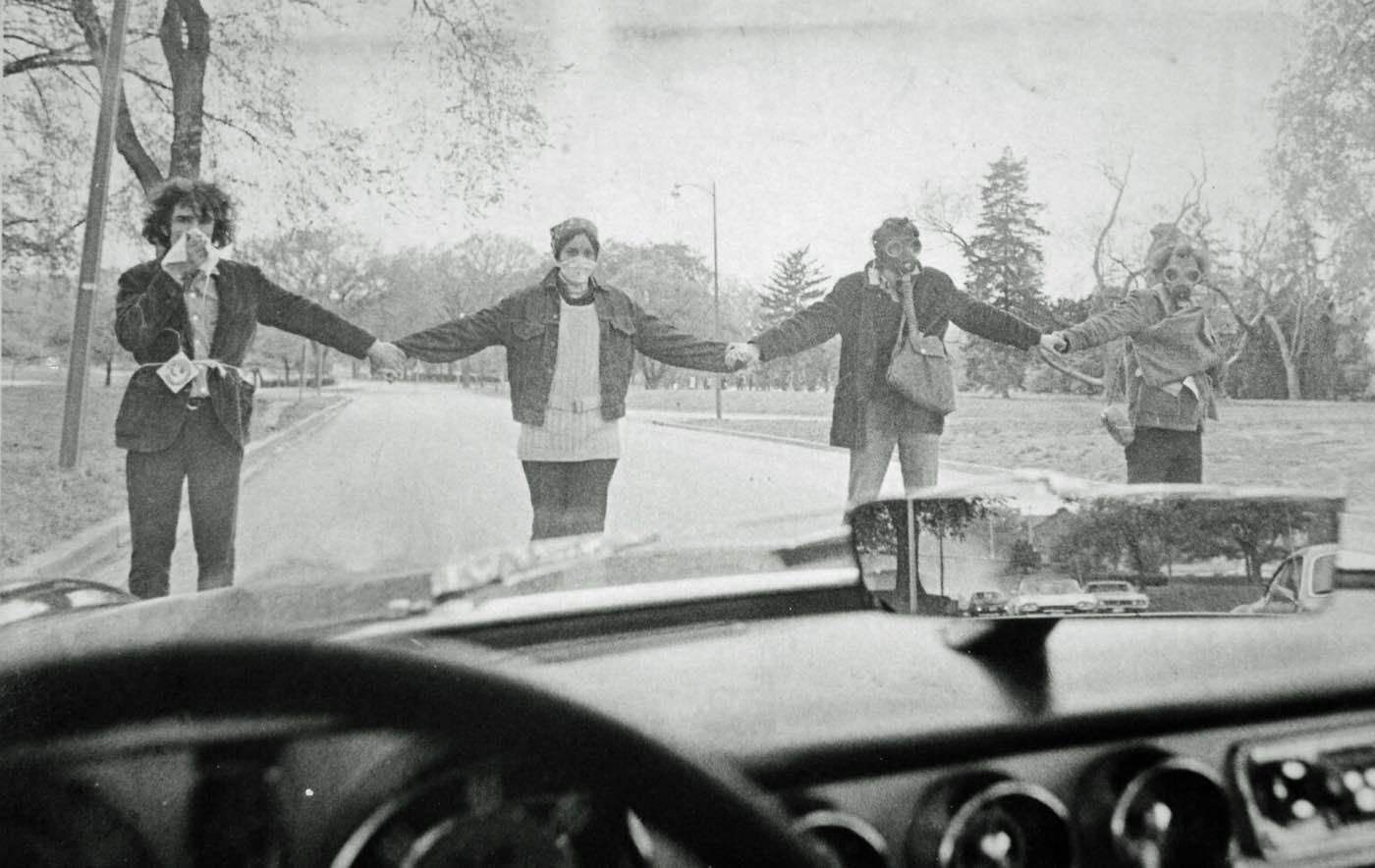
An affinity group blocks traffic near the Washington Monument, the week of May Day 1971.
Tracing the Thread
The fact that anarchist ideas and models rapidly proliferated in the movements that emerged from the Stonewall uprising lends weight to the hypothesis that anarchists played a meaningful role in the uprising itself.
The GLF and the Motherfuckers both drew on the affinity group organizing model that they had absorbed from the Spanish exiles and Murray Bookchin, but each employed it in their own way. Setting out to create a new way of life on the chaotic Lower East Side, the Motherfuckers devised insurrectionary approaches to social conflict while seeking to prefigure a revolutionary society by exploring new conceptions of the family. Gay liberationists, operating in a criminalized sexual subculture involving people linked by desire rather than shared politics, also developed alternative modes of kinship, networks of mutual aid, and flexible organizational formats that facilitated horizontal collaboration across lines of difference.
Over the course of a week in the hot summer of 1969, they collided with each other as they fought the police side by side. While the Motherfuckers dissolved shortly thereafter, gay liberation exploded and spread around the country. At the 1971 May Day protests, the two threads that converged at the Stonewall Uprising—gay liberation and anarchist direct action—came back together to transmit the affinity group model to posterity, setting the template for affinity group-based mass mobilizations for decades to come.
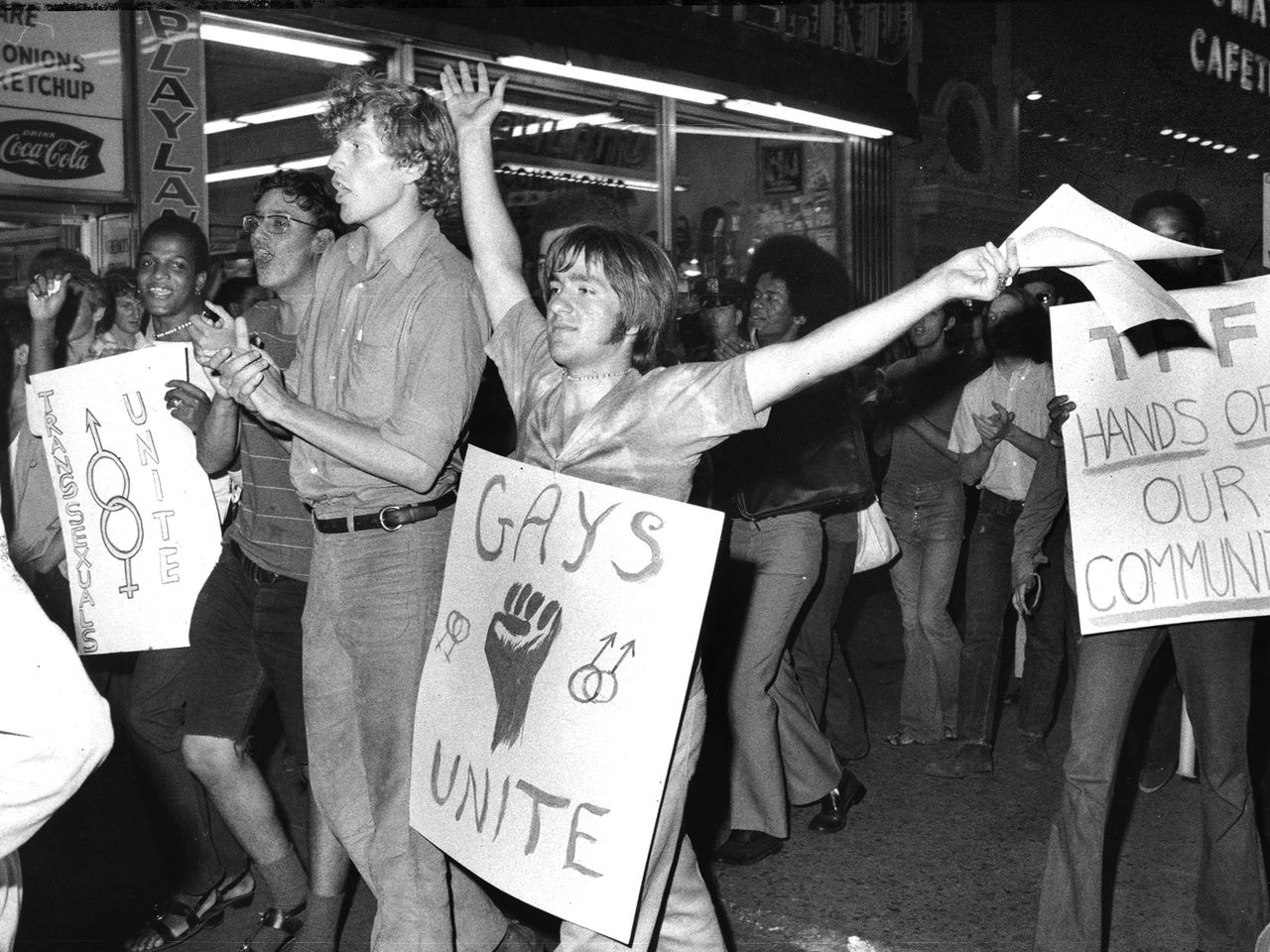
A march in 1970. Marsha Johnson is holding the trans sign at the left.
Epilogue: Commemorating Stonewall beyond “Pride”
Every June, queers around the world celebrate Pride—the co-opted consumerist shell that remains of the celebrations in memory of the Stonewall Uprising of 1969.
The first “Pride” was the Christopher Street Liberation Day March, launched in 1970 by radical gay and lesbian activists intent on breaking with the moderate homophile movement of the 1960s. Thousands of marchers convened in Greenwich Village and marched north through the city, chanting “Gay power! Gay power!”—”Gay, gay, all the way!”—”Out of the closets, into the streets!” The march was non-commercial, open to everyone, trans-inclusive, and radical, concluding in a massive “Gay-in” in Central Park. As lesbian historian Lillian Faderman summed up the day, “Never in history had so many gay and lesbian people come together in one place and for a common endeavor.”’
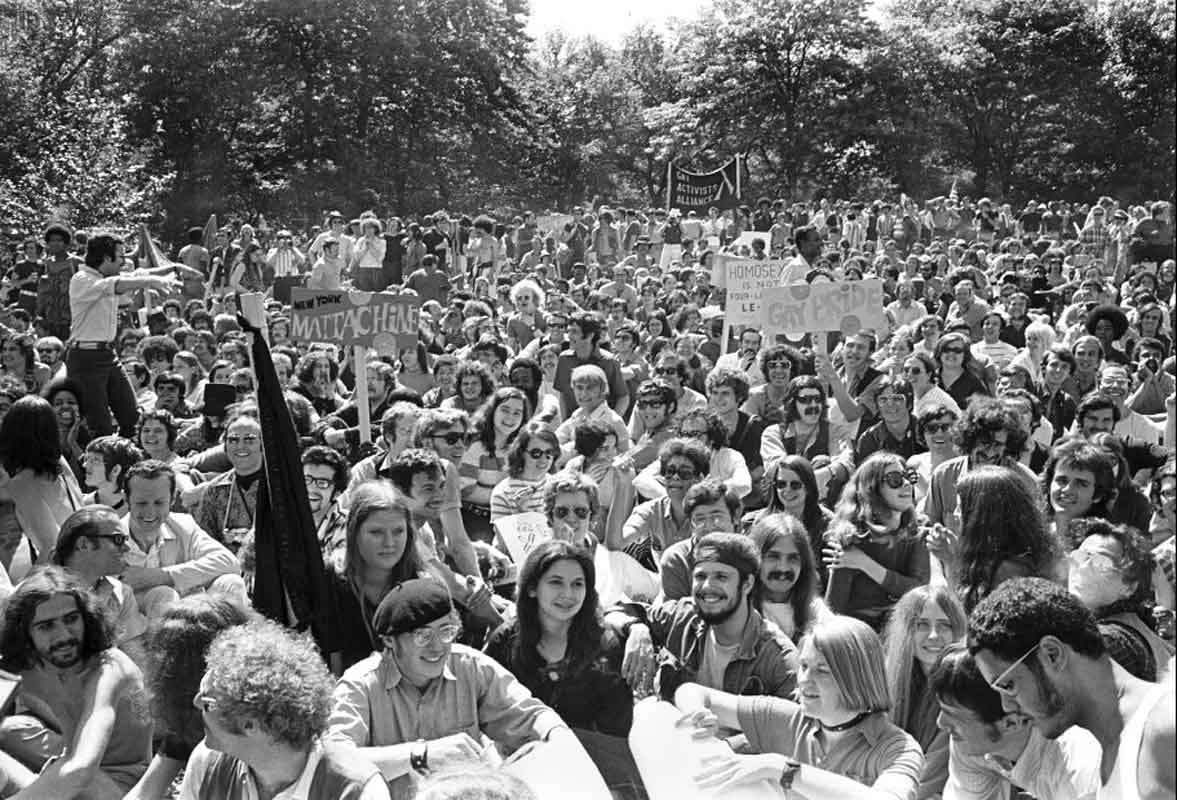
Christopher Street Liberation Day March, 1970—the first “Pride.” Yes, there was a black flag there!
Today, looking out over the landscape of contemporary Pride, we could say that rarely have so many LGBTQ people come together in one place while managing to accomplish so little. Depending on where you live, you may be charged admission for the privilege of wandering around and spending more money in a sea of commercial vendors, corporate sponsors, and tables of polite community groups. Despite the waves of resistance to racism and police violence in the late 2010s and early 2020s, you’re likely to see cops marching in the parade. In some states, organizers’ pre-emptive compliance with drag bans has gutted even the playful apolitical entertainment that we used to have.
Of course, the anti-LGBTQ and specifically anti-trans backlash of the past decade has caused many corporations that opportunistically sought out gay consumers via Pride sponsorships to dial back their efforts. Should we be nostalgic for the days when we had the luxury of complaining about being a target market rather than a target for bigotry, scapegoating, and violence?
The history we have explored here offers a different perspective on the legacy of Stonewall, pointing to a long-running cross-pollination between anarchist organizing and queer culture and sexuality. Consulting this, we see that queer anarchism is not just an intersection of discrete identities, but a transformative force that has played a central role in half a century of direct action and revolutionary ferment. Looking at Stonewall through this lens, we see how the queer riots of 1969 offer lessons that are directly applicable to today’s movements for liberation.
This account of the Stonewall Uprising leaves no room for consumerism, cops, or hierarchical leaders. According to this version of the story, we celebrate the rebels of June and July 1969
When we help to push riots beyond a single night of disturbances into an ongoing rebellion against the ruling order;
When we resist the efforts of community representatives to defuse our anger and send us home;
When we mingle in the streets against the instructions of riot cops, politicians, and official activists, communicating and finding common cause;
When we evaluate our strategies and tactics to find ways to revolt more effectively and joyously;
When we organize horizontally, rejecting representation and leaders, making space to collaborate while insisting on autonomy;
When we form affinity groups to undertake our creative and destructive projects;
When we prefigure the horizontal worlds we desire beyond the workplace, the party, and the nuclear family in the ways we organize, riot, party, and fuck.
When we do these things, we are truly honoring the legacy of Stonewall.
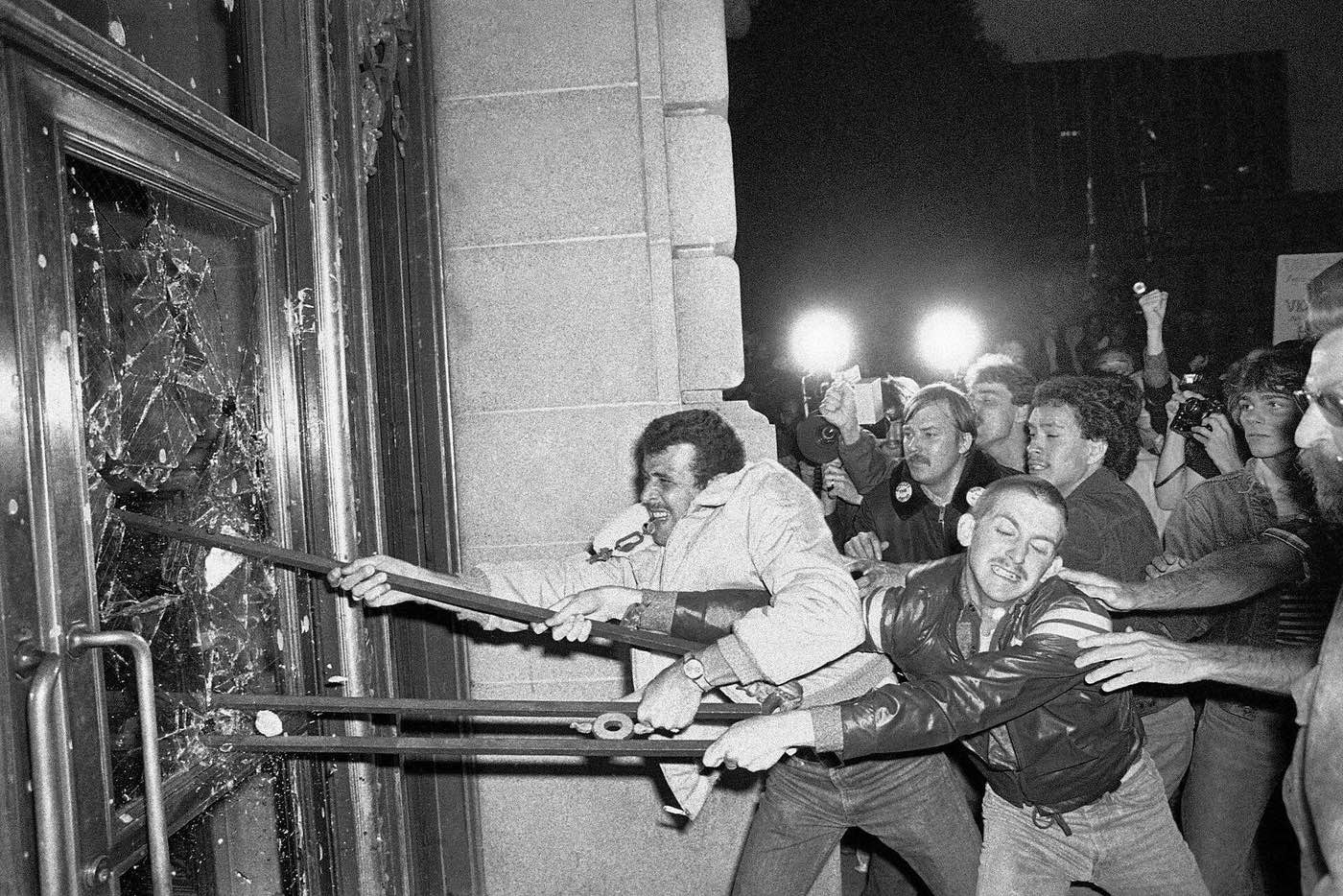
The spirit of Stonewall: gays smash City Hall during the White Night Riots in 1979.
Further Reading
- The Stonewall Riots: A Documentary Reader, ed. Marc Stein—This collection reprints 200 primary sources related to Stonewall, its origins, and its aftermath. It is the best single volume for getting into the details of the events.
- David Carter, Stonewall: The Riots That Sparked the Gay Revolution—This is the most comprehensive single narrative account of the uprising. While the book’s coverage of trans participation leaves something to be desired and Carter’s comments over Sylvia Rivera and Marsha P. Johnson have spurred accusations of racism, it remains a valuable resource.
- Donn Teal, The Gay Militants—A 1971 account that offers a blow-by-blow narrative of the emergence of gay liberation.
- Toby Marotta, The Politics of Homosexuality—A thoughtful analysis published in 1981 by a political scientist of Stonewall and gay liberation, this offers important material on Lois Hart and the early Gay Liberation Front.
- Martin Duberman, Stonewall—This book tells the story of the rebellion from the perspective of six gay/trans witnesses, including Craig Rodwell, Foster Gunnison, Jr., and Jim Fouratt, all of whom feature in our narrative, as well as Sylvia Rivera.
- Terence Kissack, “Freaking Fag Revolutionaries: New York’s Gay Liberation Front, 1969-1971“—A useful article on the Gay Liberation Front by the author of Free Comrades, the most extensive history of anarchism and homosexuality yet published.
For oral histories with Stonewall participants and GLF members, see The Gay Liberation Front Foundation and the LGBTQ History Project. Some elders are still living—reach out and talk to them!
You can find digital uploads of the GLF’s newspaper Come Out here.
Adam Nagourney Dudley Cleninden, Out for Good: The Struggle to Build a Gay Rights Movement in America—This is largely anti-radical and obnoxiously transphobic, but includes some useful material.
Hugh Ryan, The Women’s House of Detention: The Queer History of a Forgotten Prison—A queer abolitionist history of the jail a few blocks from the Stonewall.
For more about the Motherfuckers, see:
- Black Mask and Up Against the Wall Motherfucker
- Up Against The Wall Motherfucker! An Anthology of Rants, Posters, and More
- Gavin Grindon, Poetry Written in Gasoline: Black Mask and Up Against the Wall Motherfucker
- Ben Morea, Full Circle: A Life in Rebellion
- Osha Neumann, Up Against the Wall Motherf**ker.
For more about the Crazies, see Leslie James Pickering’s Mad Bomber Melville.
Our analysis of the 1971 May Day actions draws considerably from the brilliant research of L.A. Kauffman in the article “Ending a war, inventing a movement: Mayday 1971”.
For a narrative account of May Day 1971, see Lawrence Roberts, Mayday 1971: A White House at War, a Revolt in the Streets, and the Untold History of America’s Biggest Mass Arrest. You can also consult the 1971 May Day protests tactical manual.
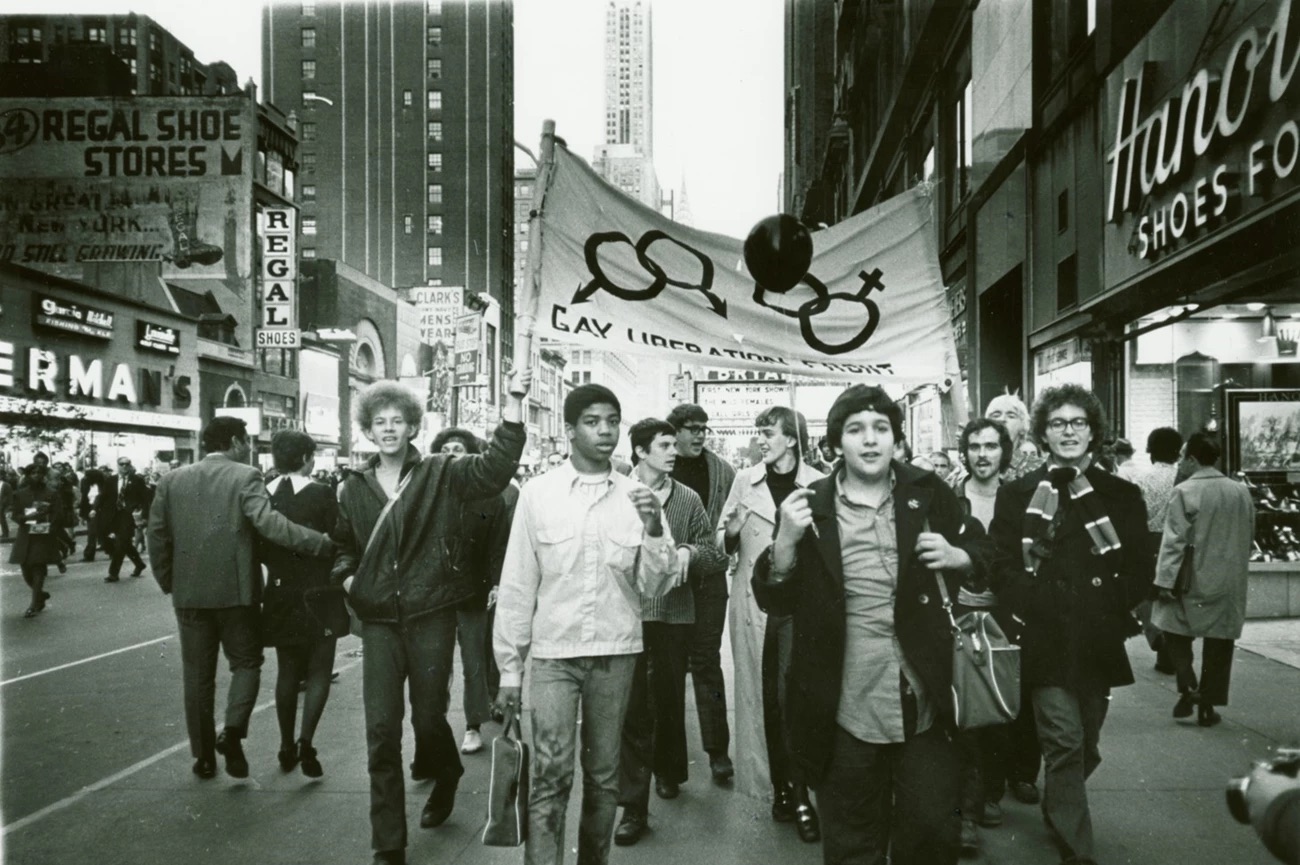
Gay Liberation Front Marches on Times Square, New York City, 1969.
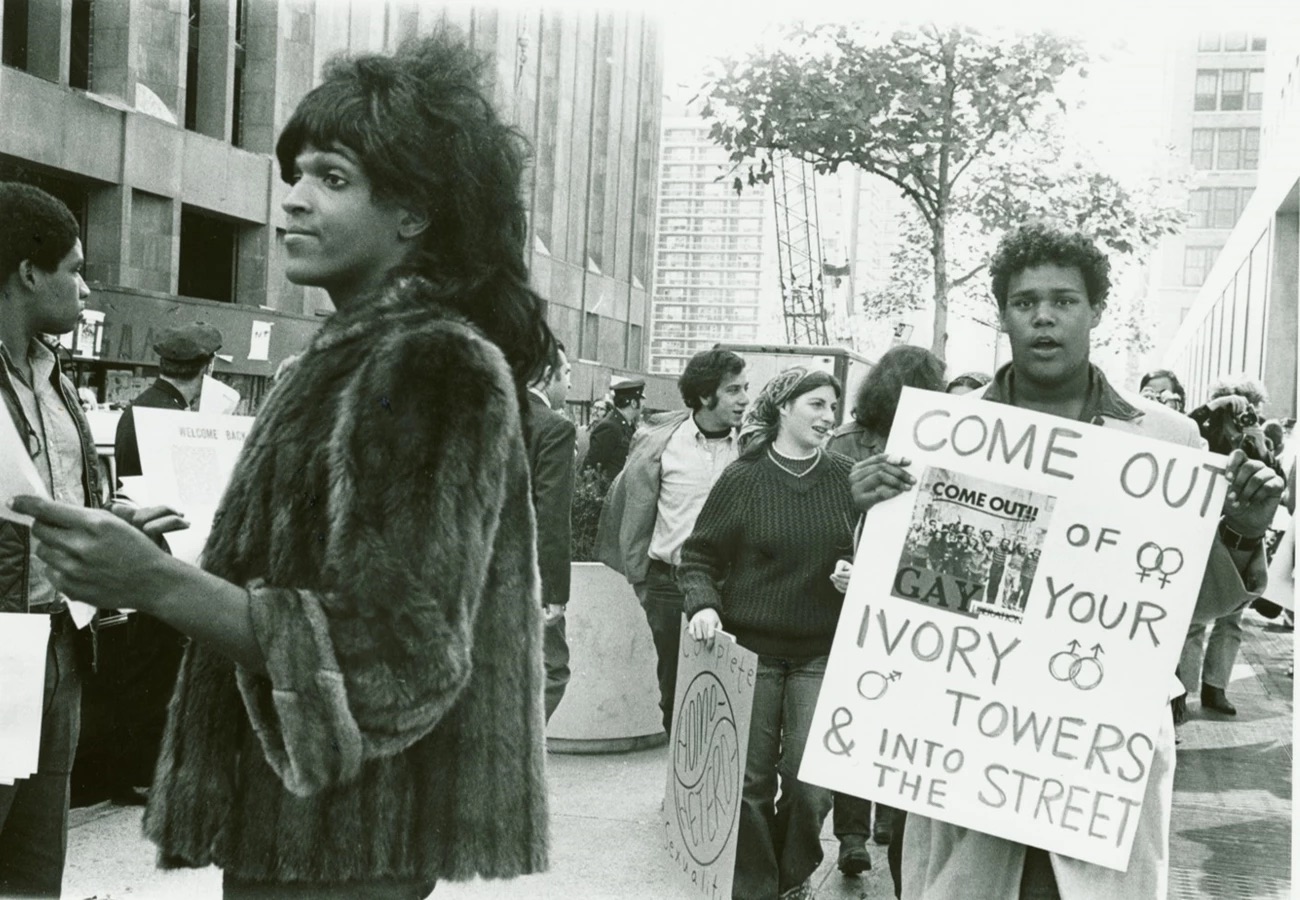
Marsha P. Johnson Hands Out Flyers in Support of Gay Students at New York University, 1970.
-
As Jim Fouratt, a young gay radical who participated in the riots, later pointed out, the question itself betrays a lack of awareness about the material conditions of the bar and its surroundings: “And who threw the first brick? Where would you find a brick on Christopher Street, unless you brought it in your purse, you know?” Danny Garvin, another participant in the riots, recalled finding a construction site on Seventh Avenue South where retreating rioters found a stack of bricks; in any case, brick throwing was not among the first acts that catalyzed the rebellion. See Carter, Stonewall, 155. ↩
-
This summary derives from a range of accounts, including Carter, Stonewall, Duberman, Stonewall, and several primary sources. ↩
-
Carter, Stonewall, 181. ↩
-
“Queen Power: Fags against Pigs in Stonewall Bust,” Rat, 9 July 1969, 6; in The Stonewall Riots: A Documentary History. ↩
-
Homophile Youth Movement, “Get the Mafia and the Cops Out of Gay Bars,” ca. 29 June 1969, Craig Rodwell Papers, Box 5, New York Public Library; in The Stonewall Riots: A Documentary History. ↩
-
According to Jefferson Fuck Poland of the Sexual Freedom League, NYC police claimed that when they raid bars, “they are not picking on homosexuals,” but focused on bar employees and on trans/gender-nonconforming patrons: “generally men dressed as men, even if wearing extensive makeup, are always released; men dressed as women are sometimes arrested; and ‘men’ fully dressed as women, but who upon inspection by a policewoman prove to have undergone the sex-change operation, are always let go.” Poland called for direct action against cross-dressing laws through a “Switch In,” in which “a large group of males and females, of all sexual orientations, should appear in clothing unmistakably of the opposite sex. Daring the cops to bust.” Jefferson Fuck Poland, “Lady Inspectors,” Berkeley Barb, 16 July 1969, 17; in The Stonewall Riots: A Documentary History. ↩
-
John Gabree, “Homosexuals Harassed in New York,” National Guardian, 12 July 1969, 14; in The Stonewall Riots: A Documentary History. ↩
-
“Queen Power: Fags against Pigs in Stonewall Bust,” Rat, 9 July 1969, 6; in The Stonewall Riots: A Documentary History. ↩
-
Interview with Hugh Ryan, 2019. ↩
-
In discussion with the authors in June 2026, Osha Neumann, one of the few living New York Motherfuckers, wasn’t sure: “I have no recollection of any MF being involved with Stonewall. That doesn’t mean some folks didn’t go there, but I somehow doubt it. By June 1969, I believe the core of the MFs were already heading to New Mexico.” But digging a bit deeper, it’s clear that the question is still open. In 2006, Motherfucker Ben Morea explained that the Motherfuckers were not a membership organization, but a network of affinity groups that acted independently and a label that any of them could employ: “We never called ourselves Up Against the Wall Motherfucker, although we signed our posters and leaflets UAW/MF, which anyone in the group could produce, with that name… It was essentially a loose confederation of affinity groups.” In fact, a wide range of people, from Mark Rudd and Spain Rodriguez to the Jefferson Airplane, dallied with both the organization and its tag line; there appear to have been autonomous chapters of Up Against the Wall Motherfucker as far away as Austin, Texas. Some people outside Motherfucker circles likely used the term to describe a wider range of people than Osha Neumann did. All of this is squarely within the anarchist tradition of informal organization. Regardless of whether members of the affinity groups specifically associated with Morea or Neumann directly took part in the Stonewall Uprising, it is certain that anarchists took part, and probable that some of them overlapped with the crews that identified—or were identified—as Motherfuckers. ↩
-
Jay Levin, “The Gay Anger behind the Riots,” New York Post, 8 July 1969, 36; in The Stonewall Riots: A Documentary History. ↩
-
D. L. [Dick Leitsch], “Gay Riots in the Village,” Mattachine Society of New York Newsletter, Aug. 1969, 1–2, 4; in The Stonewall Riots: A Documentary History. ↩
-
Bob Kohler, “Where Have All the Flowers Gone,” Come Out! 1, No. 2, (January 10, 1970). ↩
-
Carter, Stonewall, 202. ↩
-
Carter, Stonewall, 183. ↩
-
Carter, Stonewall, 302, note 21. ↩
-
Hugh Ryan, The Women’s House of Detention: The Queer History of a Forgotten Prison. ↩
-
Carter, Stonewall, 196. ↩
-
Leo E. Laurence, “Gays Hit NY Cops,” Berkeley Barb, 4 July 1969, 5; in The Stonewall Riots: A Documentary History. ↩
-
Carter, Stonewall, 196. ↩
-
Carter, Stonewall, 197. ↩
-
Tom Burke, “The New Homosexuality,” Esquire, December 1969, pp. 178, 304–18. ↩
-
Lucian Truscott IV, “Gay Power Comes to Sheridan Square,” Village Voice, 3 July 1969, 18; John Gabree, “Homosexuals Harassed in New York,” National Guardian, 12 July 1969, 14; in The Stonewall Riots: A Documentary History ↩
-
D. L. [Dick Leitsch], “Gay Riots in the Village,” Mattachine Society of New York Newsletter, Aug. 1969, 1–2, 4; in The Stonewall Riots: A Documentary History. ↩
-
Leitsch, “Gay Riots in the Village.” ↩
-
Leitsch, “Gay Riots in the Village.” ↩
-
“Cop Injured 5 Seized in Village,” New York Post, July 3, 1969. ↩
-
Carter, Stonewall, 205. ↩
-
Ronnie Di Brienza, “Stonewall Incident,” East Village Other, 9 July 1969, 2; in The Stonewall Riots: A Documentary History. ↩
-
Leitsch, “Gay Riots in the Village.” ↩
-
Carter, Stonewall, 201-205. ↩
-
Kiyoshi Kuromiya quoted in Marc Stein, City of Brotherly and Sisterly Loves: Lesbian and Gay Philadelphia, 1945–72, 334. ↩
-
John Gabree, “Homosexuals Harassed in New York,” National Guardian, 12 July 1969, 14; in The Stonewall Riots: A Documentary History. ↩
-
Leitsch, “Gay Riots in the Village.” ↩
-
Leitsch, “Gay Riots in the Village.” ↩
-
Di Brienza, “Stonewall Incident.” ↩
-
“Gay Power Explodes,” The Insider: Newsletter of the Mattachine Society of Washington, Aug. 1969, 1–3; in The Stonewall Riots: A Documentary History. ↩
-
Donn Teal, The Gay Militants, 95. ↩
-
Don Jackson, “Reflections on the N.Y. Riots” The Los Angeles Advocate, Oct. 1969, 11, 33; in The Stonewall Riots: A Documentary History. ↩
-
Lige [Elijah Hadyn Clarke] and Jack [John Richard Nichols], “Pampered Perverts,” Screw, 25 July 1969, 16. ↩
-
Clarke and Nichols, I Have More Fun With You Than Anyone, 147. ↩
-
Carter, Stonewall, 216. ↩
-
Karla Jay, The Lavender Menace: A Memoir of Liberation, 77. ↩
-
Toby Marotta, The Politics of Homosexuality, 90. ↩
-
Donn Teal, The Gay Militants, 101. ↩
-
Marotta, The Politics of Homosexuality, 87. ↩
-
Dudley Cleninden and Adam Nagourney, Out for Good: The Struggle to Build a Gay Rights Movement in America, 43. ↩
-
Terence Kissack, “Freaking Fag Revolutionaries: New York’s Gay Liberation Front, 1969-1971,” 116. ↩
-
Late in life, immediately before renouncing anarchism, Murray Bookchin published a screed excoriating what he described as “lifestyle anarchism,” even sneering, in passing, at “gay faery circles.” Ironically, the queer liberation movement did more than any institution to spread what is useful in Bookchin’s contributions to anarchist practice. ↩
-
David Eisenbach, Gay Power: An American Revolution, 127. ↩
-
Lois Hart, “GLF News,” Come Out 1, no. 2 (January 10, 1970), 16. ↩
-
Hart, “GLF News.” ↩
-
Ralph Hall, “Gay Liberation News,” Gay Power 1, no. 9 (1969), 8. ↩
-
Donn Teal, The Gay Militants, 101. ↩
-
Donn Teal, The Gay Militants, 52. ↩
-
L.A. Kaufmann, “Ending a War, Inventing a Movement: May Day 1971.” ↩