When the Feds Come to Your City: Standing Up to ICE
:A Guide from Chicago Organizers

Are masked agents showing up in your town to kidnap your neighbors? Want to do your part to protect each other, but don’t know where to start?
We hope this guide will help you prepare to stand up to federal agencies like Immigration and Customs Enforcement (ICE) as they attempt to abduct people from your community. The guide is not exhaustive—it could not be—but it is based on the knowledge that an array of people have accumulated in Chicago over the past several months during “Operation Midway Blitz.” As federal agents expand their assaults on communities across the country, it is crucial to share and build on these practices.
Because the mercenaries who work for ICE and other federal agencies are constantly updating their strategies in response to popular resistance, a guide like this is chiefly useful for getting started thinking about how to resist. We encourage you to draw on this guide for ideas while adapting them to the local context that you and your neighbors know best.
Table of Contents
- Tools and Digital Safety
- Keeping Tabs on ICE/CBP/DHS
- General ICE Watch Guidelines
- Reactive Community Defense
- Proactive Community Defense
- Other Tactics and Activities
Tools and Digital Safety
Digital security matters. It is crucial to your own safety and the safety of those you organize with.
Protect Yourself!
We are all still learning about which aspects of our digital lives can be used against us. Don’t put yourself or the people around you at further risk: use encrypted messaging apps and documents, regularly delete anything you aren’t using, and be cautious about what you put in writing.
- Get a VPN: otherwise, everything you click on can identify your location.
- Learn which apps can identify your location; limit or turn off those sharing permissions.
- Limit your interactions with people who say “I don’t need to take precautions, I’m already on a list, I don’t have anything on my phone,” and the like.
- Use a vetting process for strategy chats to ensure that someone trustworthy can vouch for everyone who participates.
- Limit what you share in unvetted chats.
- Turn off Face ID or fingerprint ID on your phone, especially when there is a risk that you will interact with law enforcement. Police can use these to get into your phone without a warrant
Getting Started with Signal
- Enable username. Do not use your real name or photograph. Change your username often, especially after actions or interactions with law enforcement.
- Set “Who can see my phone number?” to “Nobody.”
- Disable notifications from Signal.
- Use alphanumeric passwords with at least eight characters.
- Get Signal Desktop.
- There should be at least two admins on every group chat, in case something happens to one.
- Delete Signal before traveling internationally.
- As soon as you learn that someone has been detained, delete them from all chats as quickly as possible.
Creating and Storing Documents
- Do not use Google docs or gmail. In addition to collecting all your personal information, Google saves your data on its servers and scans it for commercial purposes—and who knows what else.
- There are open-source, privacy-focused tools like CryptPad, which uses end-to-end encryption. This means that the information is encrypted and decrypted in the user’s browser, making it technically impossible for CryptPad administrators to access the contents.
Further Reading
- Activist checklist for Signal
- Security essentials checklist
- Field Guide to Police Surveillance
- How to make a faraday bag
- More tech guides
- The protesters guide to smartphone security
- A printable guide to mobile phone security
- Security Culture (printable version here)
Keeping Tabs on ICE/CBP/DHS
Learn the acronyms and agencies: Immigration and Customs Enforcement, Customs and Border Protection, Department of Homeland Security.
How to Spot ICE
How to recognize immigration enforcement agencies:
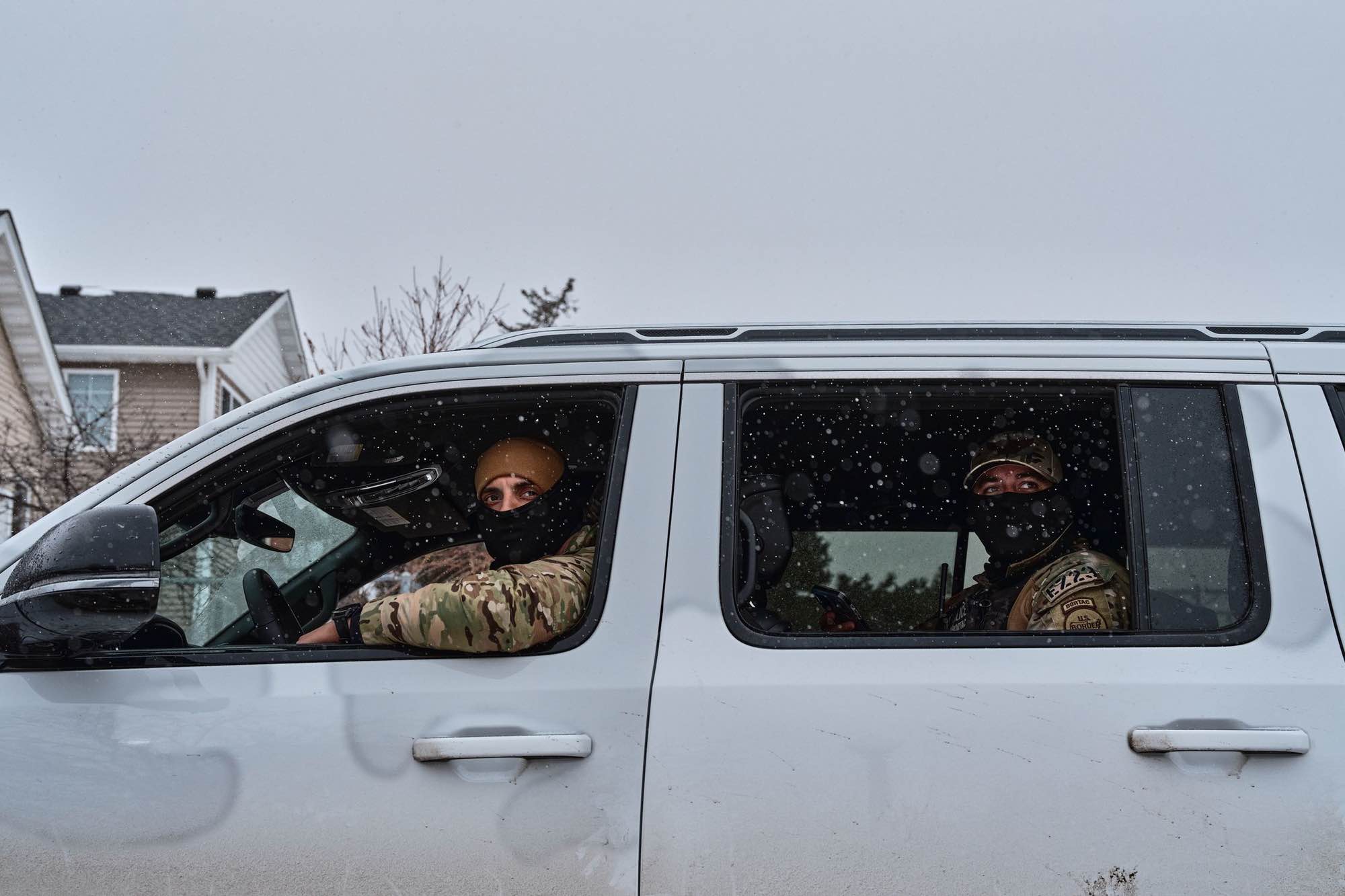
- Cars: rental cars, tinted windows, both in-state and out-of-state plates; all cars have been known to change plates.
- Agents have been spotted in sedans with Mexican flag wraps, “Chinga la migra” stickers, etc.
- Vehicles with MP (municipal police) or yellow, green or pink LV/LIVERY (luxury taxi or limo) plates are not ICE vehicles.
- FP (fleet plates) or out of state plates are often (but not always) ICE vehicles.
- ICE cars have been mostly American made (Jeep, Cherokee, GMC, Chevy, Ford, Chrysler, Dodge), generally newer models (2024-2026), mostly white, black, blue, silver, grey or dark blue.
- ICE/CBP agents don’t generally use vans for abductions, but transfer abductees in vans later. If there isn’t evidence of abductions in the area, vans are probably not ICE.
-
Once local migra watch organizers have enough experience to synthesize, it could be useful to prepare and circulate a guide to identifying ICE vehicles, such as this one.
- Officers typically wear gaiter face coverings and dark or army green clothing (fatigues).
- Border Patrol more often wear green uniforms with BP arm badges; ICE are more often plainclothes.
- Vests/uniforms may read POLICE, DHS (Department of Homeland security), ICE, CBP (Border Patrol)
- Officers travel in groups of 3-8 or more.
- It can be helpful to build a cryptpad database of all known ICE vehicles/plates including photos. Keep the authorship of the database confidential.
ICE/CBP/DHS Tactics
When seeking to escape attention, we have seen federal agents employ these tactics:
- Innocuous-looking drivers (not wearing gaiter masks, wearing plainclothes) in the front seat while uniformed/masked agents hide in the back seat behind darker tinted windows.
- Decoy cars: if agents know that rapid responders will follow them in a certain neighborhood, they may start using certain cars as decoys. Decoy cars will permit you to follow them, driving slowly rather than erratically. Sometimes, they will brake check rapid responders when a stoplight changes to enable a vehicle being used for abductions to get away. They might lure you out of the neighborhood or into an alley. In some instances, ICE has used a car to kidnap people and then switched to using it as a decoy.
- During Operation Midway Blitz, CBP openly admitted to kidnapping people based solely on their appearance. The Supreme Court ruled shortly before Midway Blitz that agents could use appearance (race) as one factor among others in making arrests. This means that appearance and working a low-wage job together can add up to “reasonable” suspicion of being undocumented.
- Agents tend to target people who are alone or isolated. They seize people quickly: most abductions are over in less than two minutes.
- The most vulnerable people are those who are outside alone: street vendors, day laborers, landscapers, construction workers, unhoused people.
Risks
Risks to be aware of during ICE watch and rapid response activities:
- Agents have deployed tear gas and pepper balls against crowds in residential neighborhoods. You can get a respirator mask and goggles at a hardware store. This guide explores how to protect yourself from chemical weapons and projectiles.
- Run trainings in chemical weapon safety and decontamination for the general public, and get as many people as you can trained as action medics.
- CBP/ICE agents often stop rapid response volunteers and threaten to arrest them for “impeding,” alleging that following them, honking, or blowing a whistle counts as impeding operations.
- CBP/ICE agents may look up rapid responders’ license plate numbers and announce their names over the loudspeaker as a means of intimidation; there have even been reports of agents leading rapid responders to the responders’ own homes to convey an implicit threat.
Further Reading

A federal mercenary threatens civilians in the Brighton Park neighborhood of Chicago on October 4, 2025.
General ICE Watch Guidelines
If you show up during an abduction:
- Whistle (long blast) to alert neighbors.
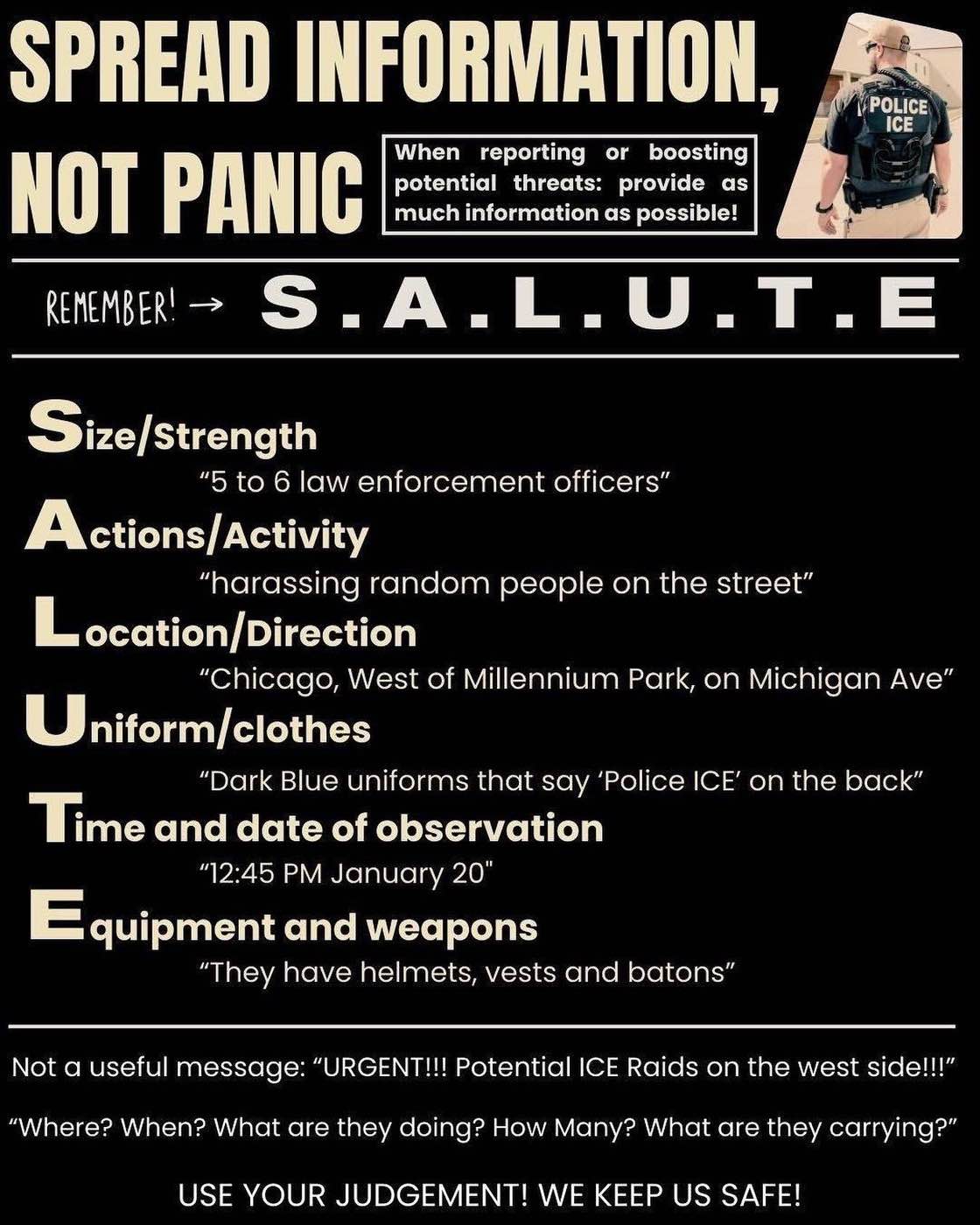
- Document Size, Activity, Location, Unit/Uniform, Time, Equipment (SALUTE)
- Size: How many agents and how many vehicles? Take photographs of agents, vehicles, and license plates, as possible.
- Activity: What exactly are the agents doing? If someone is detained and you know their name, phone number, or date of birth, note it.
- Location: Give an exact address or intersection.
- Unit(s): What letters, details, or patches are visible on their uniforms, jackets, vests, vehicles? Examples: HSI/Homeland Security Investigations/Police Gang Unit, ERO (Enforcement and Removal Operations), POLICE, CBP/US Customs and Border Protection, CBP Field Operations, POLICE DHS.
- Time: What precise time did you witness this? Share the information quickly.
- Equipment: What did agents have with them? Examples: weapons, flexicuffs, dogs, door breakers, LRAD sound cannon, vans, SUVs.
- Film and photograph the interaction, with an emphasis on documenting the agents and preserving the detainees’ privacy as much as possible. Get the car information, the agents’ assigned numbers and last names, and what kind of force they used.
- Speak to the detainee. Try to get their name and date of birth and call the local hotline with this information (in Chicago, it is the Illinois Coalition for Immigrant and Refugee Rights).
If you show up after an abduction:
- Canvass the area. Speak to loved ones, witnesses, business owners. Explain that you are a neighbor responding to a report of an abduction. Try to get as much of an idea of what happened as possible, and report it to your rapid response/ICE watch group. One easy way to start these conversations is to carry flyers or cards with know your rights information or resources. Keep these in your car or bag in case you need to canvass.
- Get video of the abduction from bystanders or store security cameras. Don’t share this to social media—send it to an existing repository of information that can be forwarded to families or legal teams. If none exists, send the footage to the family and try to connect them with legal counsel.
- Listen while respecting boundaries. People may be traumatized by seeing their neighbor taken and may not understand what you are doing or what side you’re on. Try not to ask for too much personal information up front; focus on what you need to do to help the person who was abducted and their family.
- ICE often leaves victims’ cars abandoned and unlocked, frequently containing their phone, wallet, ID, and valuables. Often, their captives have no way to contact family. When responding after an abduction, do your best to contact family and help tie up loose ends. Think proactively about what you would need in that situation and do your best to provide it.
Whistle protocol:
- Wear a whistle to signal to others in the area when ICE is present or conducting an abduction.
- Short, broken blasts means “I see ICE (agents or vehicle).”
- Long, continuous blast means “ICE is abducting someone.”
- The idea is to enable vulnerable folks to get inside or away, while responders form a large, loud crowd.
- Printable whistle info zines
Posting Reports to Chats
It’s important to keep migra watch chats both vigilant and actionable. When people are afraid, they are more likely to report activity that is not actually a threat. This clogs up chats and hotlines and makes everyone more paranoid. Some rules of thumb for reporting:
- Do not share in chats: vehicles that match the general characteristics of ICE vehicles but lack suspicious details.
- Such vehicles might have characteristics in common with ICE vehicles, such as tinted windows or out-of-state plates, or resemble previously-reported ICE vehicles, but lack features that confirm ICE involvement.
- Take a closer look if you can! Who is driving and riding in the car? Are they wearing masks or tactical gear? Is the car accompanied by similar cars or driving oddly? If you can’t get additional information or don’t see anything suspicious, keep an eye out, but avoid reporting.
- Do share in chats: unconfirmed vehicles that match the general characteristics and include some suspicious elements.
- Share SALUTE information. For example: “Black Jeep Wagoneer, license plate NY 12345. Seen at Washington and Wells driving south on Wells at 12:14 pm.”
- Note any additional suspicious details, such as two men in the front seats, unusual or evasive driving, multiple vehicles driving close together.
- When reporting, note that the vehicle is unconfirmed. If there is an existing database of confirmed ICE vehicles, someone else in the chat can cross reference the car and plates to check.
- Do share in chats: Vehicles with strong or confirmed evidence of ICE involvement.
- Share SALUTE information including the evidence, such as seeing people in vests or with face covers, or matching a license plate to a previous report.
- Send alerts through all appropriate Signal channels and call your local hotline to report a confirmed sighting.
Safety and Security
Reduce risks and keep each other safe during ICE watch:
- Buddy up. Discuss risk tolerance in advance with your buddies.
- If riding a bike, do not stop in front of an ICE vehicle.
- It can be dangerous to follow ICE into alleys, parking garages, or other locations where you might find yourself trapped.
- ICE agents will often try to evade pursuit by getting on and off highways, speeding, cutting red lights, and driving against traffic.
- Wear a mask or otherwise cover your face.
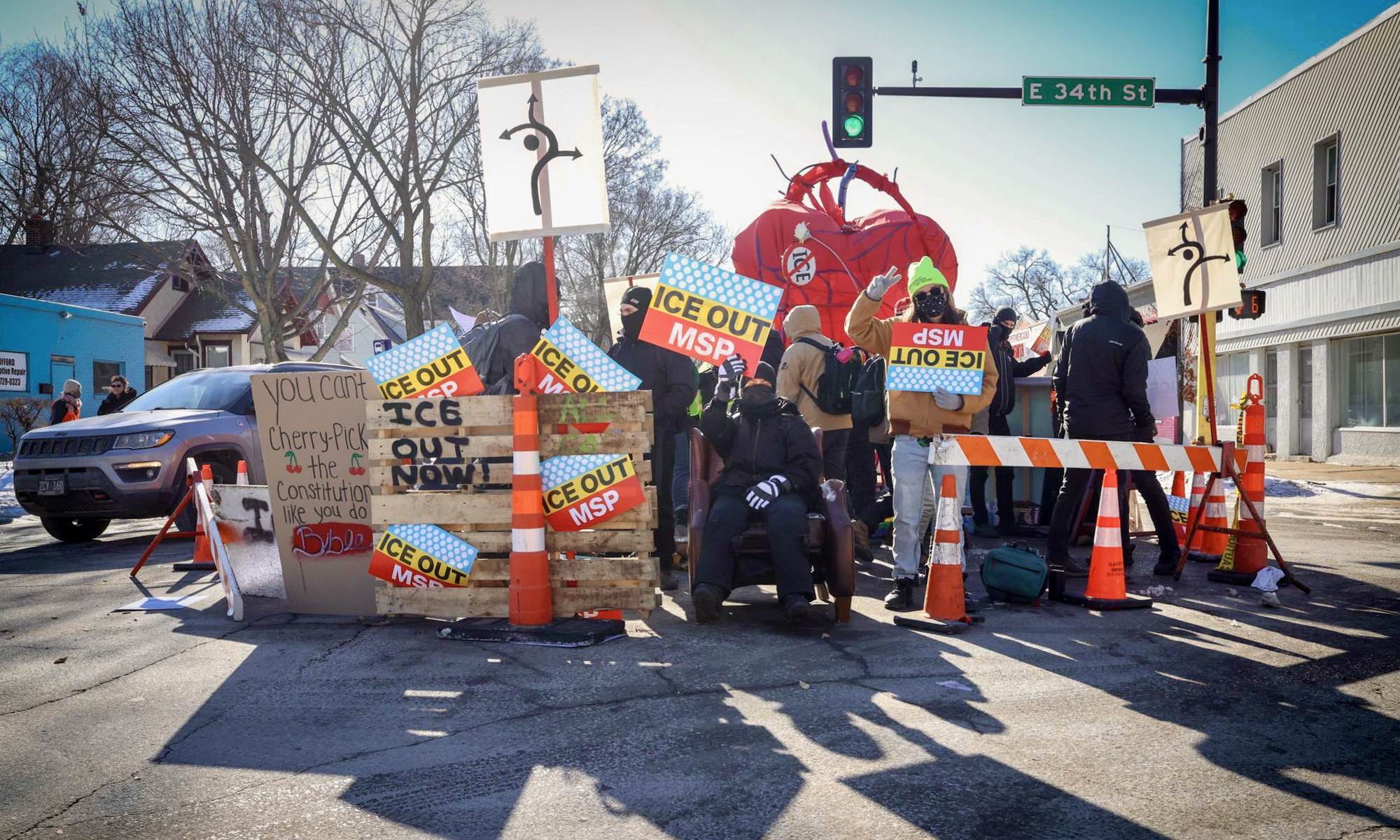
- Federal agents sometimes use militarized equipment, low-flying helicopters, and the like to scare people. Stay safe, but don’t let those tactics erode your sense of community. If you are not at risk, spend more time outside of your house than usual, connect with neighbors, eat at local restaurants. The more eyes on the city, the better.

Reactive Community Defense
Goal: to respond to activity and abductions that are already happening.
Advantages:
- You can gather a crowd to a given site quickly if enough people know whistle protocol. Strength in numbers.
- A larger crowd can obtain clearer SALUTE documentation and information about detainees.
Rapid Response Overview
- Rapid response groups mobilize as soon as possible to locations where there are reports of ICE activity. Because federal agents move fast, rapid response is only as effective as it is widespread. A good system includes strong communication networks between as well as within neighborhoods and towns.
- Rapid response is brave and risky. Responders may encounter agents who threaten them or deploy aggressive tactics, including chemical munitions and arrest. Do not engage in rapid response alone.
- Agents will try to make you feel scared and powerless. However, we have seen that they often back off or avoid locations when rapid responders are around.
- Once an abduction is taking place, it can be difficult and dangerous to try to stop it. The top priority of rapid response is to draw immediate attention to what is happening, document it, and get the identifying information of the detainee so that they cannot be disappeared.
How to Start a Vetted Rapid Response Group
- Find neighbors you trust to be responders or dispatchers. Get their Signal usernames and add them to a “waiting room” group chat. Create a vetting form (you can use Cryptpad forms) and share it with the waiting room group.
- Never assume that any group is completely secure. The chief vulnerability of Signal loops is that infiltrators can join them under false pretenses. Even those who have proven themselves to be reliable in the past may change their behavior, especially under pressure.
- Map the neighborhood. It helps to create and draw “zones” on an existing map so that dispatchers can schedule coverage of specific zones for specific blocks of time.
- Establish shared expectations. Everyone should have a shared understanding of the risks of rapid response and how to stay safe while doing it.
- Agree on group norms. For example, do not share detainees’ or responders’ personal information via group chat; message when you head out and back; no side conversations.
- Determine and train dispatchers. Dispatchers can relay messages from other nearby rapid response groups with reports of ICE activity and vehicles, and try to verify information that others post in your chat. Dispatchers can try to flesh out incomplete reports via direct messaging.
- Dispatchers will ask people to turn out to a particular location where there is activity, or to post up at surrounding streets as the agents leave.
- Ideally, a few dispatchers can rotate being “on duty,” taking on different times and days throughout the week.
- Try to keep non-reporting messages to a minimum. This can clog the chat with other discussions or insufficient information, making it slower for responders to take in reports and act quickly when it counts.
Further Reading
- Verifier chat guidelines from an anonymous neighborhood group (in English and Spanish)
Proactive Community Defense
Goal: to prevent or at least limit future abductions by creating a safe, well-networked community.
Advantages:
- higher likelihood of spotting agents before kidnappings happen
- enables the participants to build better infrastructure of care and faster channels of communication in a neighborhood, which can prove crucial when agents strike.
Mutual Aid
- Share money, rides, supplies, skills, space, time. We keep each other safe, supported, and fed.
- Take care of those who are at risk of kidnapping: If you buy out a vendor’s supply for the day or pick up a vulnerable friend’s kids from school, they can stay home and don’t have to risk abduction on the street. Carpools and grocery runs serve the same purpose. If giving money, consider using cash.
- Take care of fellow responders: Those who are able to be out patrolling on weekdays may not have as much money for supplies (and vice versa). If you can’t leave during the day but have access to funds, you could buy vests and whistles or respirator masks and goggles for local rapid response groups and school patrols. Pick up pizza for a community defense meeting! Access to secure meeting spaces—churches/temples, library meeting rooms, and the like—is also tremendously valuable.
- Share your skills. Are you a graphic designer, artist, or spreadsheet maker? Do you know a lot about bike safety or local laws? Can you babysit for free or cook massive amounts of food on short notice?
- If there are existing mutual aid networks/collectives in your town or neighborhood, ask them what they need.
Patrols
- Patrols are slightly different from rapid response; instead of responding to known abductions, patrols cover an area preventatively, to watch for ICE agents.
- The same rapid response chat and infrastructure can serve patrols.
- You can patrol on foot, by bike, or by car; there are different advantages to each. Depending on capacity, your neighborhood may have patrollers out every day, or only when ICE activity has been reported nearby.
- Most neighborhood schools in Chicago have formed school watch groups. Usually, parents or school community members have created Signal groups and signup spreadsheets that identify the times during which coverage is needed, the intersections or locations where volunteers are needed, and an option for volunteers to sign up and indicate whether they have attended a migra watch training.
- While any patrol can escalate quickly, school watch is a good option for those who can only commit to a regularly scheduled, time-bound community defense activity. It’s a good activity for those who are not prepared for higher-risk patrols or rapid response.
- If you want to help out at a school but don’t know how to get involved, arrive before pickup time at the end of the day and look for volunteers gathered outside.
Protect Folks at Work
- Many ICE abductions in Chicago have taken place at workplaces or day laborer hiring corners.
- Canvass businesses in your area with information about how businesses can protect their employees within local/state laws.
- This is especially important for visibly immigrant-owned businesses. Make sure the canvassers can speak the same language as the business owners and employees.
- Find ways for shop owners and workers to safely report sightings to rapid responders.
- Encourage them to use Signal, and encourage area-specific Signal chats for businesses in the same area to connect and alert rapid responders to sightings and other incidents.
- Adopt a hiring corner. If there are street vendors or day laborer pickup sites in your area, you can post up nearby and watch for incoming vehicles from the street corner. If you are near a regular spot or stationary vendor, briefly explain what you are doing.
- Distribute Know Your Rights information in multiple languages while doing community patrol or watch.
- Consistent coverage at hiring corners is ideal. These have been hit hardest in Chicago.
Start a Community Defense Center
Also known as a Centro or hub.
- Choose trusted people from rapid response networks and identify a place to set up a community defense center (for example, at a hiring corner, a Home Depot, an open market, or a park).
- A little folding table with snacks, beverages, reading material, and supplies can create opportunities for deep community connections and ways to keep each other safe.
- Centros can also work as hubs to connect neighborhood patrols including school or bike patrols, coordinating to promote quick communication about needs and threats.
- Develop a plan for what to do if ICE is sighted, where it is safe for people to go, how to follow up after a sighting or kidnapping. Ask vulnerable people (for example, day laborers, street vendors, landscapers) if they have a plan and if you can play a supporting role.
Know Your Local Laws
- How are the local police likely to behave? Can private businesses bar entry to ICE? Many different laws have some technical bearing on this; these may even change from one day to the next as a consequence of court cases. Find people who can educate about these factors and keep up with how they affect your efforts and your community.
- Chicago has an “ICE-Free Zone” ordinance prohibiting ICE from using city-owned property as a staging ground and establishing that privately owned properties can prohibit ICE from entering their businesses. However, ordinances like this are only useful if enough property owners know and care about them and feel prepared to enforce them.
- In Illinois, the Trust Act prohibits state and local police forces from aiding in immigration enforcement. State police have nonetheless regularly brutalized anti-ICE protestors in Broadview. By contrast, Louisiana has no such law, so Louisiana law enforcement can aid and abet ICE in New Orleans even more freely. Knowing the local and state legal landscape may help you anticipate which scenarios to prepare for.
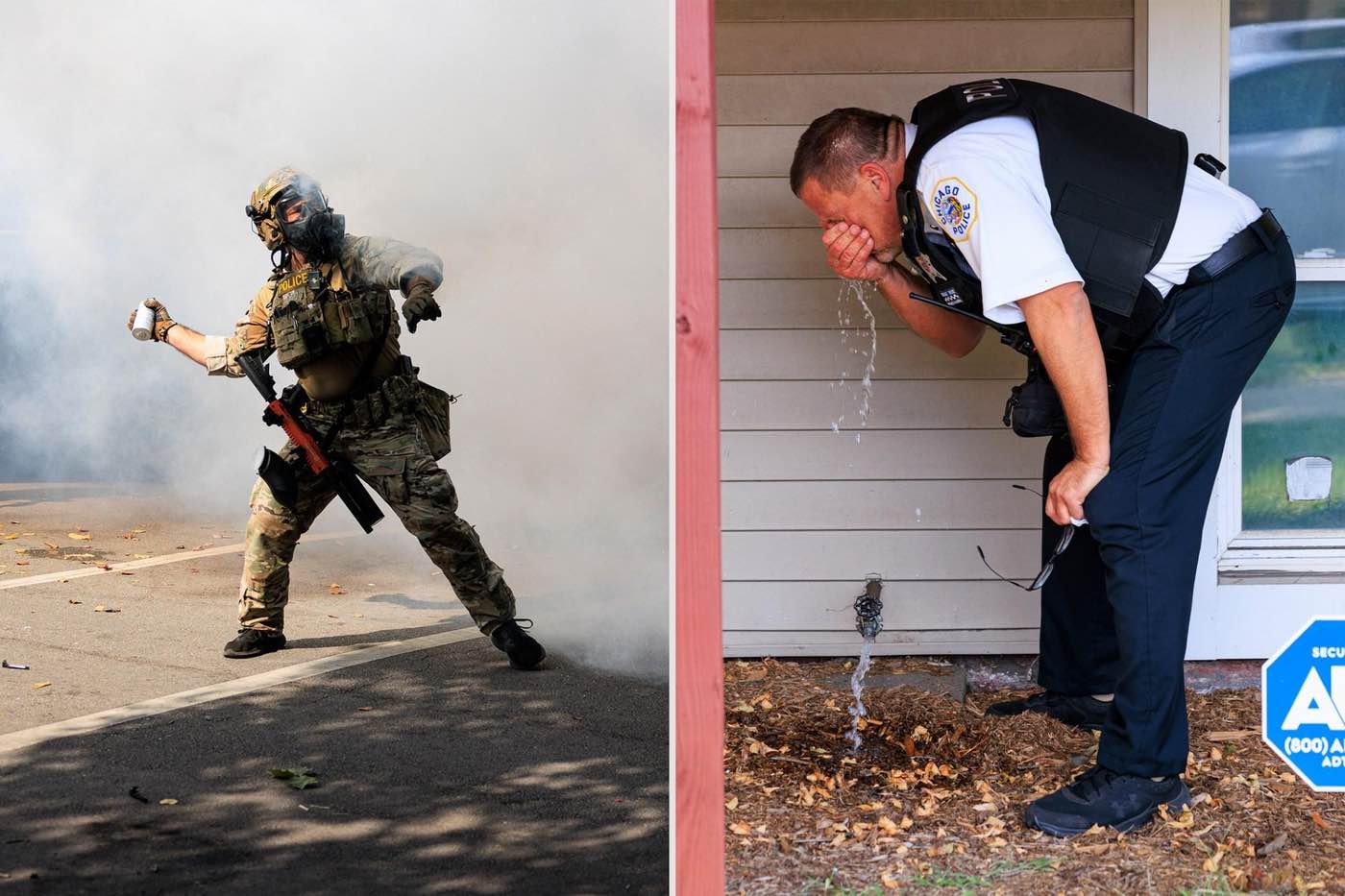
A federal immigration agent throws a tear gas canister at people on October 14, 2025 at 105th Street and Avenue N; a Chicago police supervisor who did not have a gas mask washes the irritant from his eyes afterwards. It can be valuable to map the legal and political fault lines between local, state, and federal mercenaries.
Further Reading
- Bike Patrol guidelines from an anonymous neighborhood group
- A Demonstrator’s Guide to Body Armor
- A Demonstrator’s Guide to Gas Masks and Goggles—Everything you need to know to protect your eyes and lungs from gas and projectiles.
- A Demonstrator’s Guide to Helmets
- A Demonstrator’s Guide to Lockdowns and Blockades
- A Demonstrator’s Guide to Operational Security
- A Demonstrator’s Guide to Reinforced Banners
- Preparing for, Protecting Against, and Treating Tear Gas and Other Chemical Irritant Exposure
- De-Arrest Primer
- Defend our neighbors defend ourselves! Community Self-Defense from LA to Chicago (Printable version): A guide for building centros and community hubs
Other Tactics and Activities
- ICE watch trainings
- This covers basic practices for migra watch. A nonprofit or other formal group can usually host it.
- This can prepare community members to look out for agents and activity, so they know who to call and what to do if they do see something.
- It is good to make sure as many people as possible have done this training before starting patrols or a rapid response network.
- Know Your Rights trainings
- These cover the legal rights that community members have during interactions with ICE (for example, the agents must have a warrant, you don’t have to open the door for them, and the like). These are generally oriented towards those at risk of deportation, but groups in Chicago have occasionally organized Know Your Rights trainings specifically for participants in rapid response networks.
- You can find lists of zines from the ACLU, the Illinois Coalition for Immigrant and Refugee Rights, the National Immigrant Justice Center, and similar organizations. Consider handing out Know Your Rights material in multiple languages in high-risk areas.
- Whistle kit assembly nights
- Usually organized autonomously.
- Volunteers make little kits with a whistle and an informational zine to distribute at allied local businesses or among community groups. A good activity for folks who are not able to engage in higher-risk tactics. In Chicago, lots of neighbors have 3D-printed whistles for these.
- You can find a file to 3D-print whistles here.
-
Anti-ICE community assemblies can enable existing networks to recruit participants and coordinate, as well as providing a venue for brainstorming new initiatives.
-
Research local ICE logistics to identify choke points and other strategic opportunities.
-
A media group can organize to prepare infographics and circulate videos in order to get information out quickly.
-
Helicopter watch guide—For tracking the activity of police and government aircraft.
- Chicago is one of the most surveilled cities in the world, according to Lucy Parsons Labs. Learn as much as you can about police surveillance in your community.
Further Reading: Broader Reflections
- Make Ready: Safeguarding Our Movements against Repression
- Eight things you can do to stop ICE (print version)
- Wait and See
And finally, an important rule of thumb.